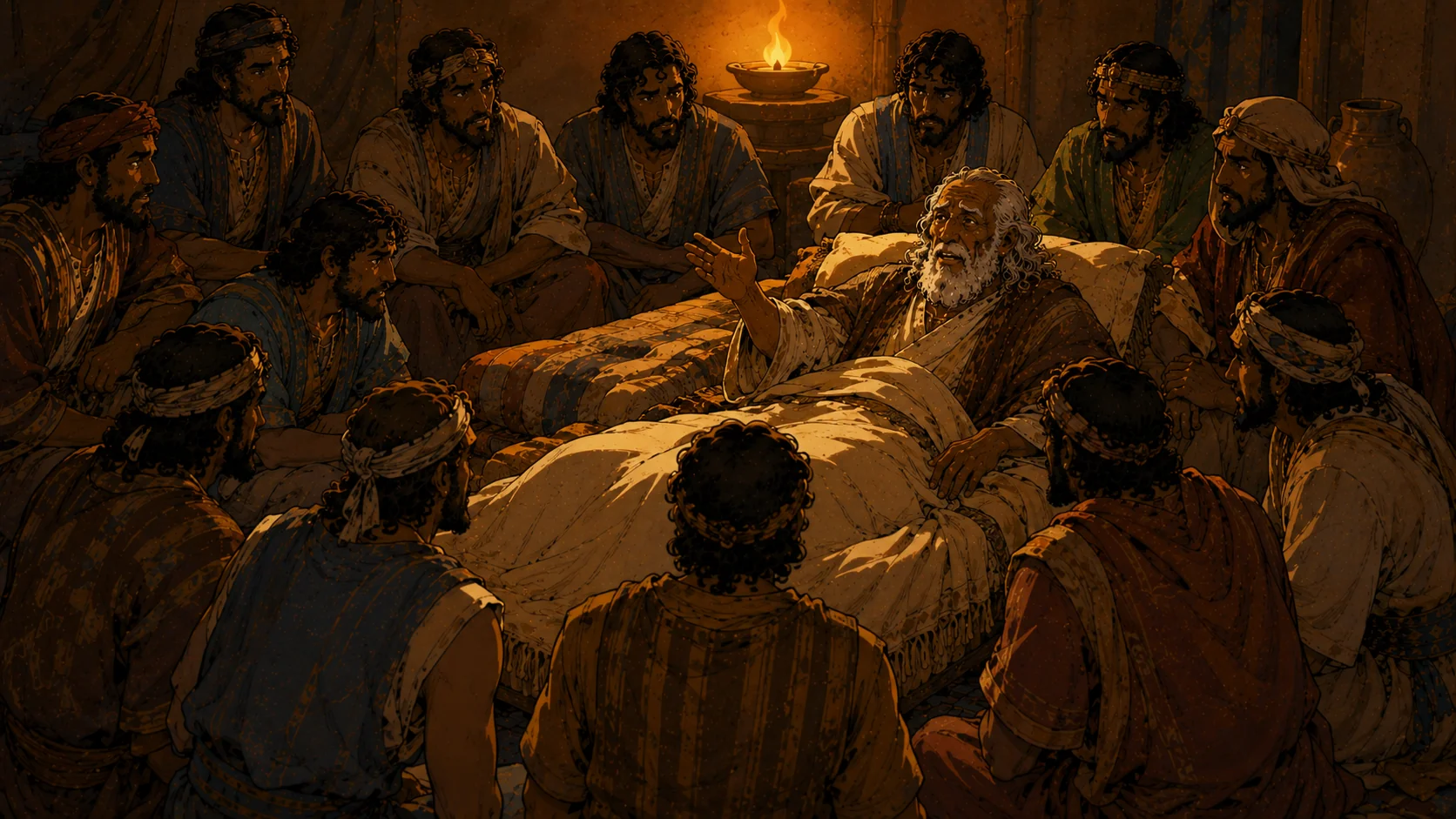
Jacob gathers all twelve sons around his deathbed and delivers the longest prophetic speech in Genesis — 27 verses of poetry over every son. He declares at the outset that this is not final advice but prophecy about the end of days. Each son receives a blessing that carries the weight of tribal destiny. Reuben: "unstable as water, you will not prevail" — he forfeited the firstborn blessing for violating Bilhah. Simeon and Levi: "their anger was fierce, their fury cruel" — because of Shechem they will be scattered in Israel. Judah: "the scepter will not depart from Judah, nor the ruler's staff from between his feet, until Shiloh comes" — the founding Messianic prophecy, the line from which David and his heirs will come.
Zebulun will dwell at the seashore. Issachar: a strong donkey crouching between the sheepfolds, bearing burdens. Dan: a snake in the road, a viper on the path, biting the horse's heels. Gad: a troop will press on him, but he will press on their heel. Asher: his bread will be rich, providing delicacies for kings. Naphtali: a swift deer speaking beautiful words. Joseph receives the longest blessing of any son: a fruitful vine, attacked by archers but his bow remained firm — "by the hands of the Mighty One of Jacob, the Shepherd, the Rock of Israel." Finally Benjamin: a ravenous wolf, devouring prey in the morning and distributing plunder in the evening.
These are not benedictions in the modern sense — they are prophetic constitutions. Each blessing defines a tribal character, a destiny, a way of being in the world. They will be fulfilled across centuries of Israel's history in the roles of each tribe. The twelve blessings are the founding document of the twelve tribes of Israel, spoken over men who were only beginning to become peoples. Jacob ends: "All these are the twelve tribes of Israel."
