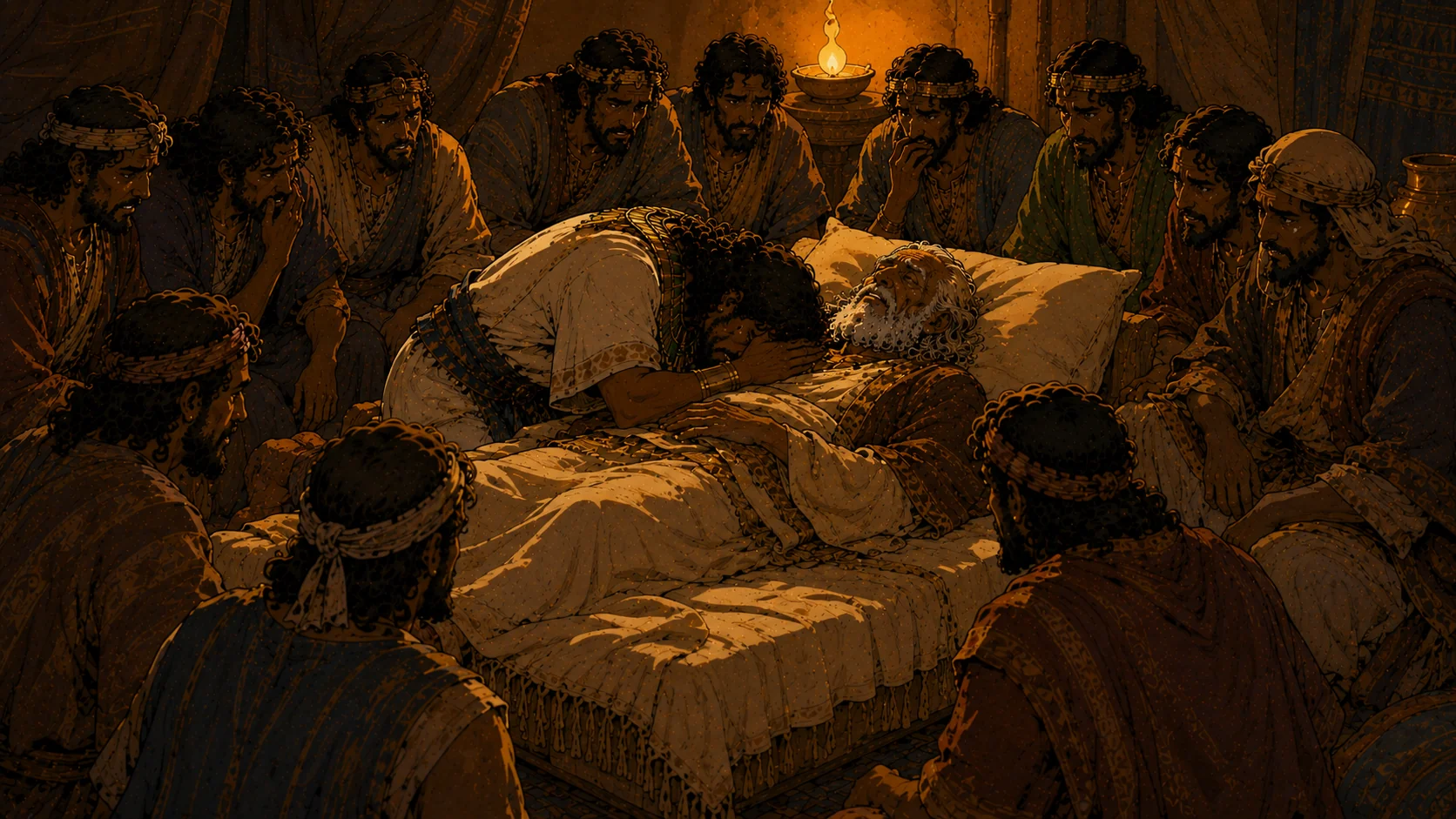
The final blessing delivered, Jacob gives his last instruction: "I am being gathered to my people. Bury me with my fathers in the cave at Machpelah in the field of Ephron the Hittite in Canaan — where Abraham and Sarah are buried, where Isaac and Rebekah are buried, where I buried Leah." He names the place with legal precision, as Abraham purchased it with legal precision. Then he gathers his feet onto the bed and dies. The Hebrew uses vayigva — a word specific to patriarchal death, distinct from the common word for dying. And then vaye'asef el amav: he was gathered to his people. Death, in the Torah's vocabulary, is a gathering.
Joseph falls on his father's face and weeps and kisses him. Then he commands the Egyptian physicians to embalm him — an exclusively Egyptian practice, foreign to Israel's customs. Forty days for the embalming. Seventy days of mourning by all Egypt. The whole nation mourns the patriarch of Israel as if he were one of its own rulers. The man who entered Egypt as a refugee shepherd with 70 dependents is mourned with the protocol reserved for pharaohs.
The extended mourning creates practical time to arrange the journey to Canaan for burial. But it also creates a theological irony: Jacob's body is preserved by Egyptian methods used for those who believed the body must be kept for the afterlife. Jacob's body is preserved, but not for the Egyptian reason. He is going home. The coffin is in Egypt; the destination is Machpelah.
