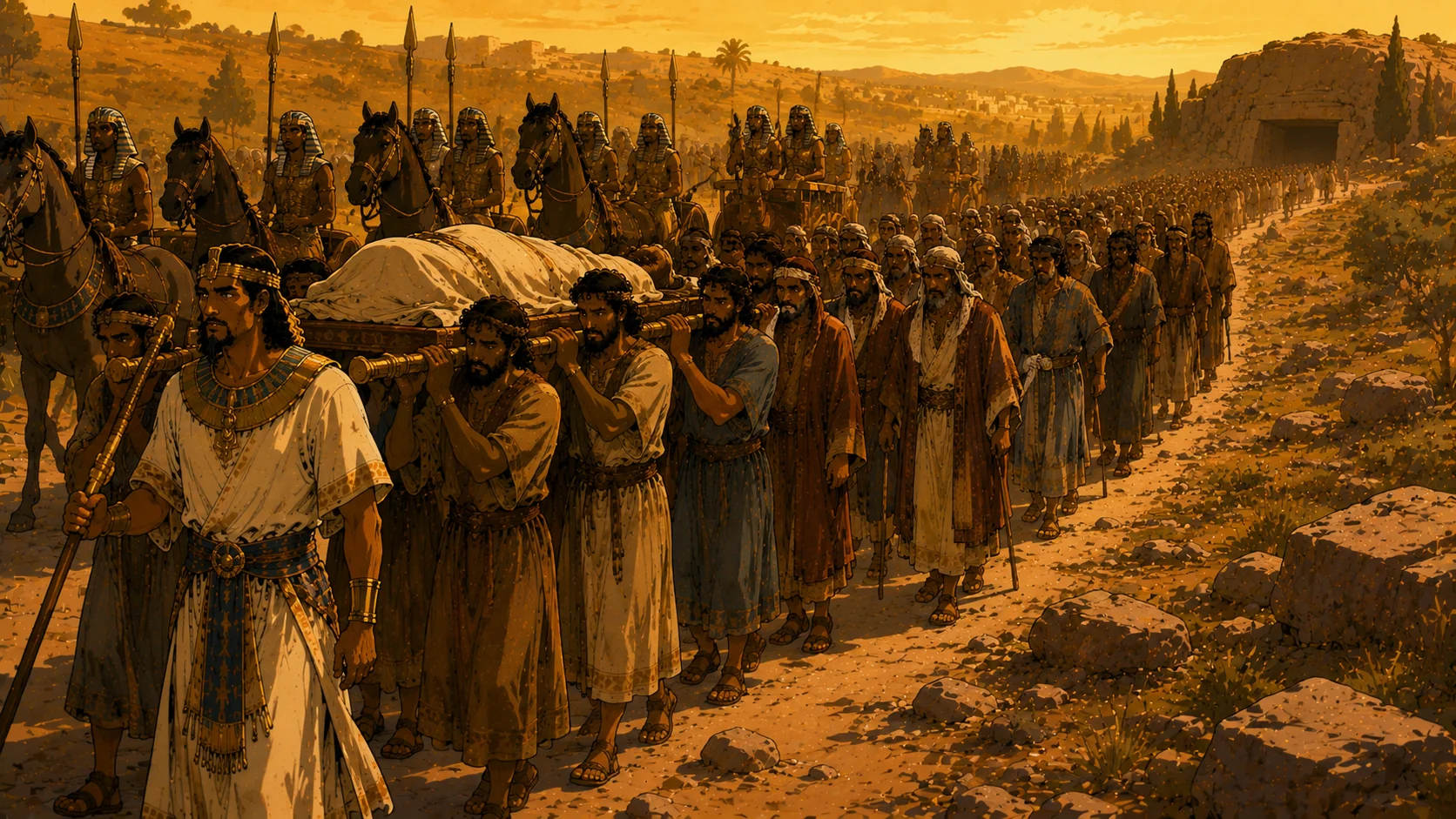
After the seventy days of mourning, Joseph requests permission from Pharaoh's court to carry his father to Canaan for burial, as Jacob had made him swear. The permission is granted immediately. The procession that departs Egypt is extraordinary: all Pharaoh's servants, all the elders of Egypt, chariots and horsemen — "a very great company." Joseph brings all of Jacob's household, leaving only the children and flocks in Goshen. This is not a family funeral. It is a state cortège — the full weight of Egyptian power accompanying the patriarch of Israel on his final journey.
The Canaanites observe the procession at the threshing floor of Atad beyond the Jordan and are astonished by the scale of the mourning. They name the place Abel Mitzrayim — which the text explains as "meadow of Egypt" but which in Hebrew can also be read as "mourning of Egypt" (evel Mitzrayim). Egypt's grief over a Hebrew patriarch left its mark in Canaan's geography. The brothers carry Jacob to the cave of Machpelah, purchased by Abraham from Ephron the Hittite 200 years earlier. The first legal real estate transaction in the Bible. The only land Israel owns in Canaan during the entire patriarchal period. Jacob is laid with Abraham, Sarah, Isaac, Rebekah, and Leah.
Then the whole procession returns to Egypt. Joseph and his brothers cross back into their exile, carrying the knowledge of what their father declared: God will surely visit you and bring you up from this land. The burial was not a homecoming. It was a preview. The bones that matter most, at this moment in the story, are still in Egypt.