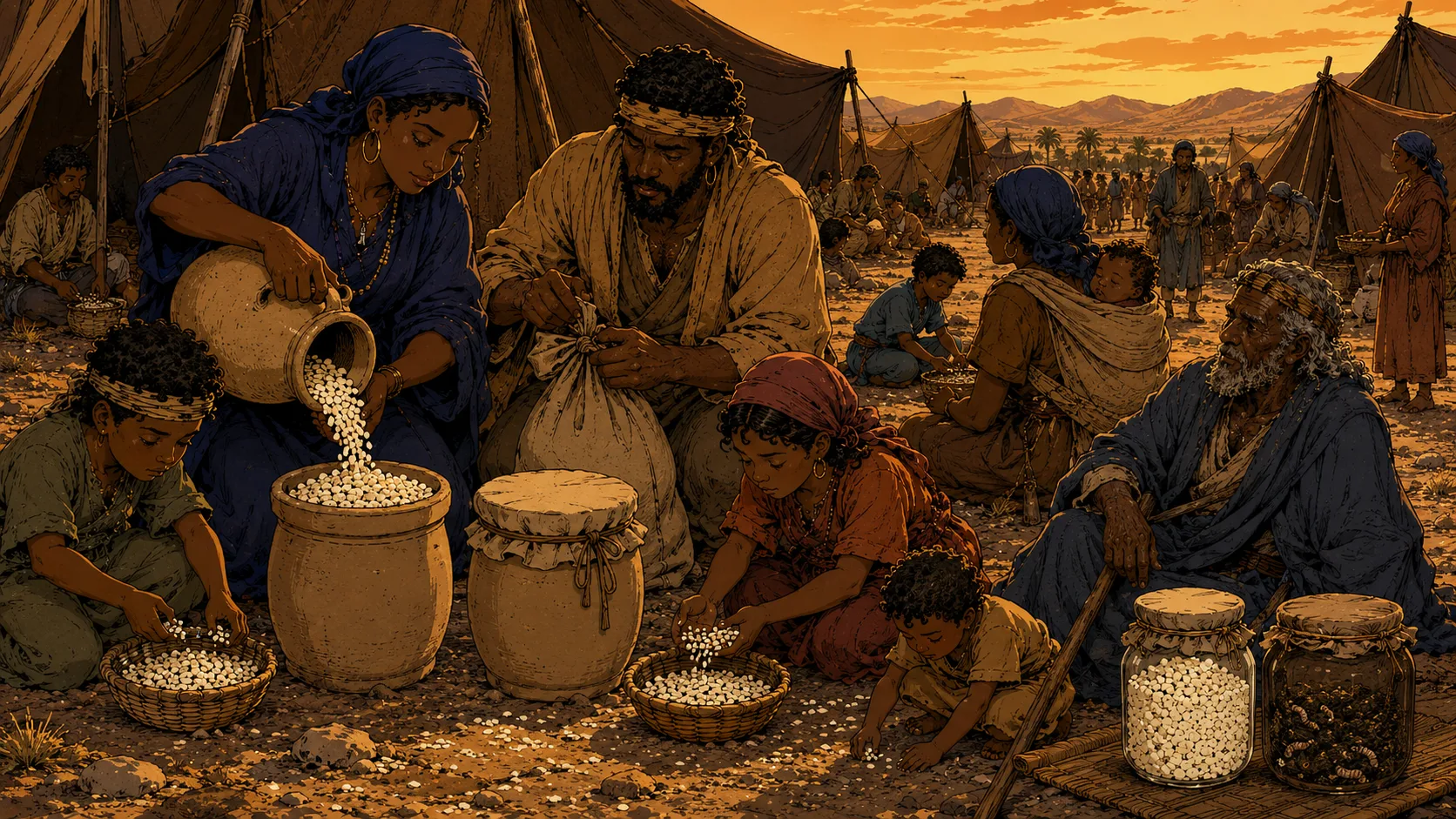
YHWH instructs Moses: each person shall gather an omer of manna for each person in their household — no more, no less. When they measure what they have gathered — whoever gathered much has nothing over, and whoever gathered little has no lack. Each person has exactly what they need. The manna cannot be hoarded. It is calibrated to the person who gathers it, and it rots overnight, producing worms. It is not food for storing. It is food for today.
But on the sixth day the leaders bring word to Moses: we gathered twice as much — two omers per person. Moses says: this is what YHWH has spoken. Tomorrow is a Shabbaton — a day of solemn rest — a holy Sabbath to YHWH. Bake what you will bake today. Boil what you will boil today. Whatever remains, keep it until morning. On the Sabbath, it will not stink. The worms will not appear.
This is the first time the word Shabbat appears as a commanded observance. The Sabbath has been present in creation since Genesis 2:2–3 — God rested on the seventh day and sanctified it. But Israel has never been commanded to rest. In Egypt there was no Sabbath for enslaved people; Pharaoh's building schedule did not observe a seventh day. Now, in the wilderness, before Sinai, before the Ten Words, God teaches the Sabbath through the manna. He builds it into the bread.
Some of the people do not listen. On the seventh day they go out to gather and find nothing. YHWH says to Moses: How long will you refuse to keep my commandments and my laws? See — YHWH has given you the Sabbath. Therefore on the sixth day he gives you bread for two days. Remain each in his place. Let no man go out of his place on the seventh day. The people rested on the seventh day. The discipline of the Sabbath — the cessation, the trust that food is provided and does not need to be pursued — is being formed in a generation that knew only the ceaseless work of the brick kiln.