Amalek came and fought Israel at Rephidim. This is the first armed assault on Israel in the wilderness — not from Pharaoh, not from a nation blocking the road, but from Amalek, the descendants of Esau's grandson (Genesis 36:12). They attack while Israel is still at the water, still recovering from the quarrel at the rock. Deuteronomy 25:17–18 will remember that Amalek struck the rear of Israel's column — the tired, the weak, the stragglers — when Israel was exhausted. It was not a battle between equal armies. It was an ambush of the most vulnerable.
Moses commands Joshua — his first introduction in the text, the man who will eventually lead Israel into Canaan — to choose men and fight Amalek tomorrow. Moses himself will stand on the top of the hill with the staff of God in his hand. The battle strategy is divided: Joshua fights below, Moses prays above.
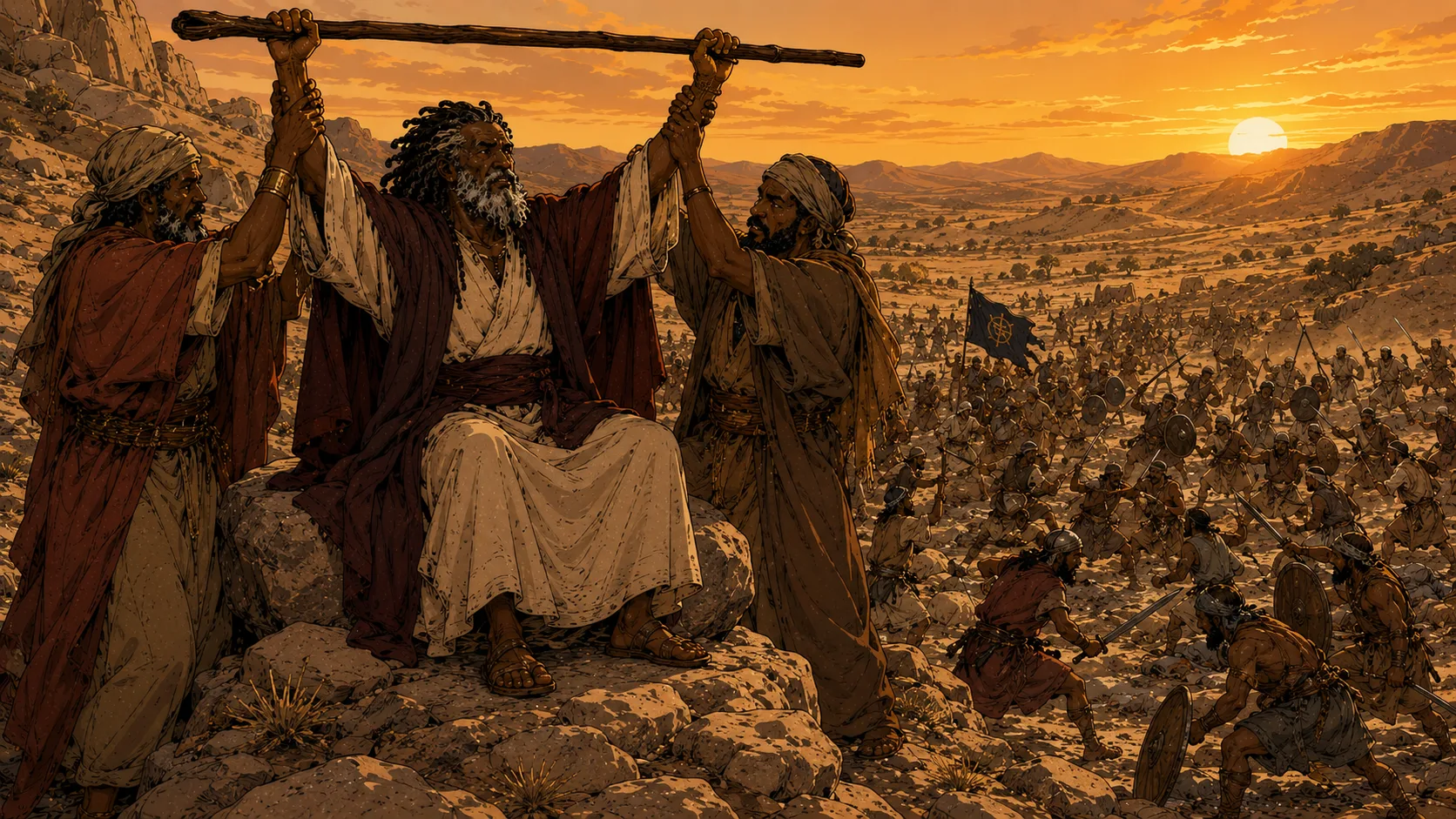
What follows is one of the Torah's most vivid pictures of intercessory warfare. When Moses raised his hand — his hands, the text implies, holding the staff — Israel prevailed. When his hands dropped from fatigue, Amalek gained the upper hand. Moses' hands grew heavy. Aaron and Hur found a stone for him to sit on. One stood on either side and held his hands up — steady — until sunset. Joshua overwhelmed Amalek with the edge of the sword.
The rabbis ask what the hands of Moses had to do with the battle. Their answer: when Israel looked upward and submitted their hearts to their Father in heaven, they prevailed. When they did not, they fell. The raised hands are not magic. They are a posture of dependence — a declaration that the outcome belongs to YHWH, not to Joshua's soldiers. The battle in the valley is won or lost on the hill.
YHWH commands Moses to write this as a memorial in a book: I will utterly blot out the memory of Amalek from under heaven. Moses builds an altar and calls it YHWH-Nissi — YHWH is my banner. For the hand is on the throne of Yah: YHWH has war with Amalek from generation to generation.