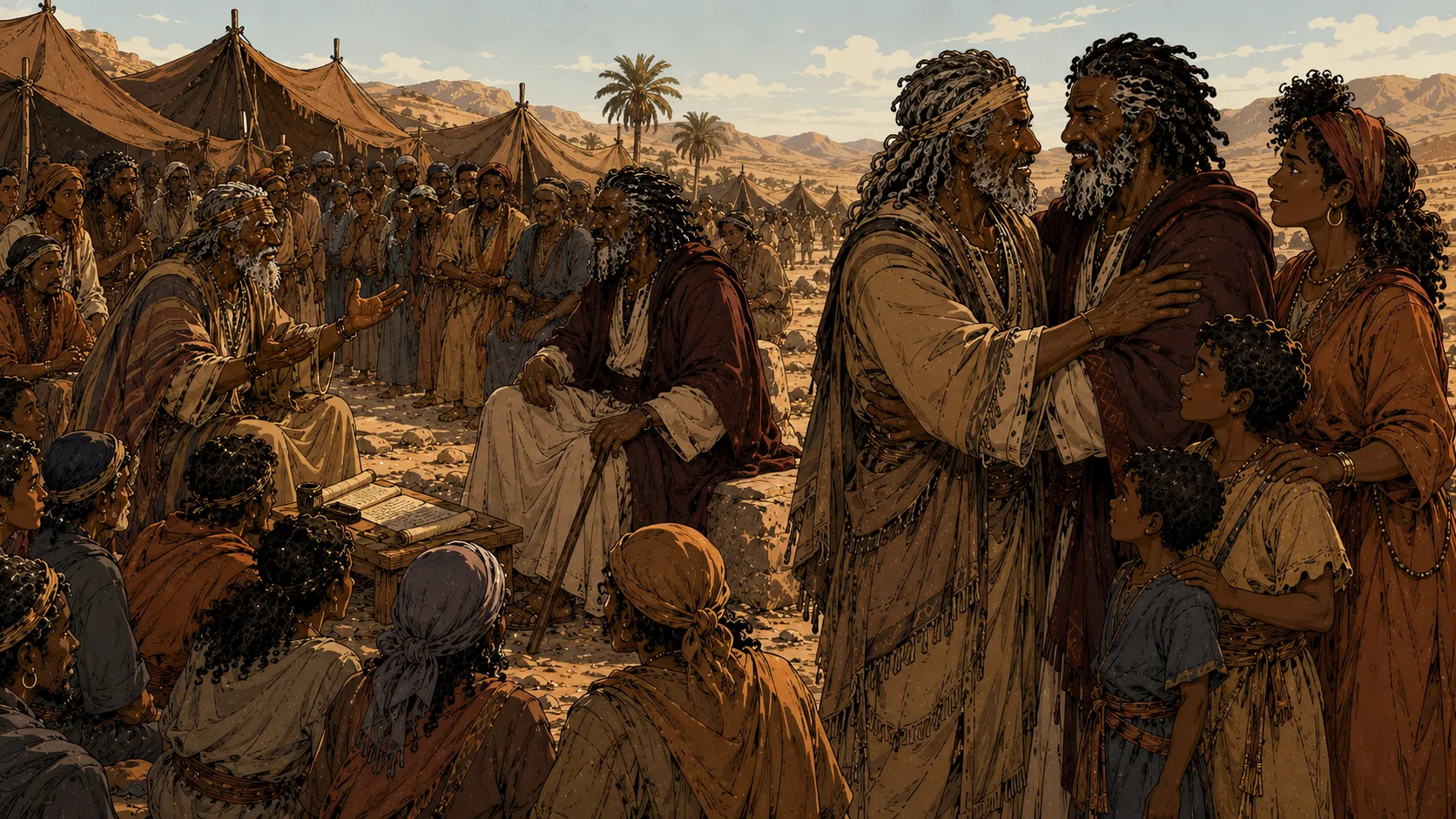
Jethro, priest of Midian and Moses' father-in-law, hears everything God has done for Moses and for Israel. He takes Zipporah, Moses' wife — who had been sent back from the journey to Egypt — and Moses' two sons, Gershom and Eliezer, and comes to Moses in the wilderness at the mountain of God. Moses goes out to meet him, bows, and kisses him. They come into the tent and Moses tells Jethro all that YHWH had done to Pharaoh and Egypt on Israel's behalf, and all the hardship they encountered on the way.
Jethro rejoices — the Hebrew word is חָדָה (chadah), to be glad with a gladness that breaks outward. He says: Blessed be YHWH who has delivered you from the hand of Egypt and from the hand of Pharaoh. Now I know that YHWH is greater than all gods. Jethro, a Midianite priest, makes the most sweeping monotheistic declaration in the book of Exodus so far — after hearing the story, not witnessing the plagues. He takes burnt offerings and peace offerings for God. Aaron and all the elders of Israel come and eat bread with Jethro before God.
The next morning, Moses sits to judge the people from morning until evening. Jethro watches. He asks: what is this you are doing for the people? Why do you sit alone, and all the people stand around you from morning until evening? Moses answers: because the people come to me to inquire of God. Jethro sees clearly what Moses cannot see from inside it: The thing you are doing is not good. You will surely wear yourself out — and the people with you. The task is too heavy for you. You cannot do it alone.
Jethro's counsel is organizational wisdom of the first order: listen to God, represent the people before him, teach them the statutes and the laws, show them the way to walk and the work they must do — and from among all the people, appoint able men who fear God, men of truth, who hate dishonest gain. Set them as rulers of thousands, of hundreds, of fifties, of tens. Let them judge the small matters. Bring the great matters to Moses. Moses listens to Jethro's voice. He chooses capable men from all Israel and sets them as heads over the people. Then Jethro departs to his own land.
This is the structure of distributed judgment — the architecture of a functioning society — given to Israel by a Midianite before they receive any law at Sinai. Wisdom comes from outside the camp. Jethro, the outsider who praises YHWH, provides the frame into which the Torah's law will be poured.