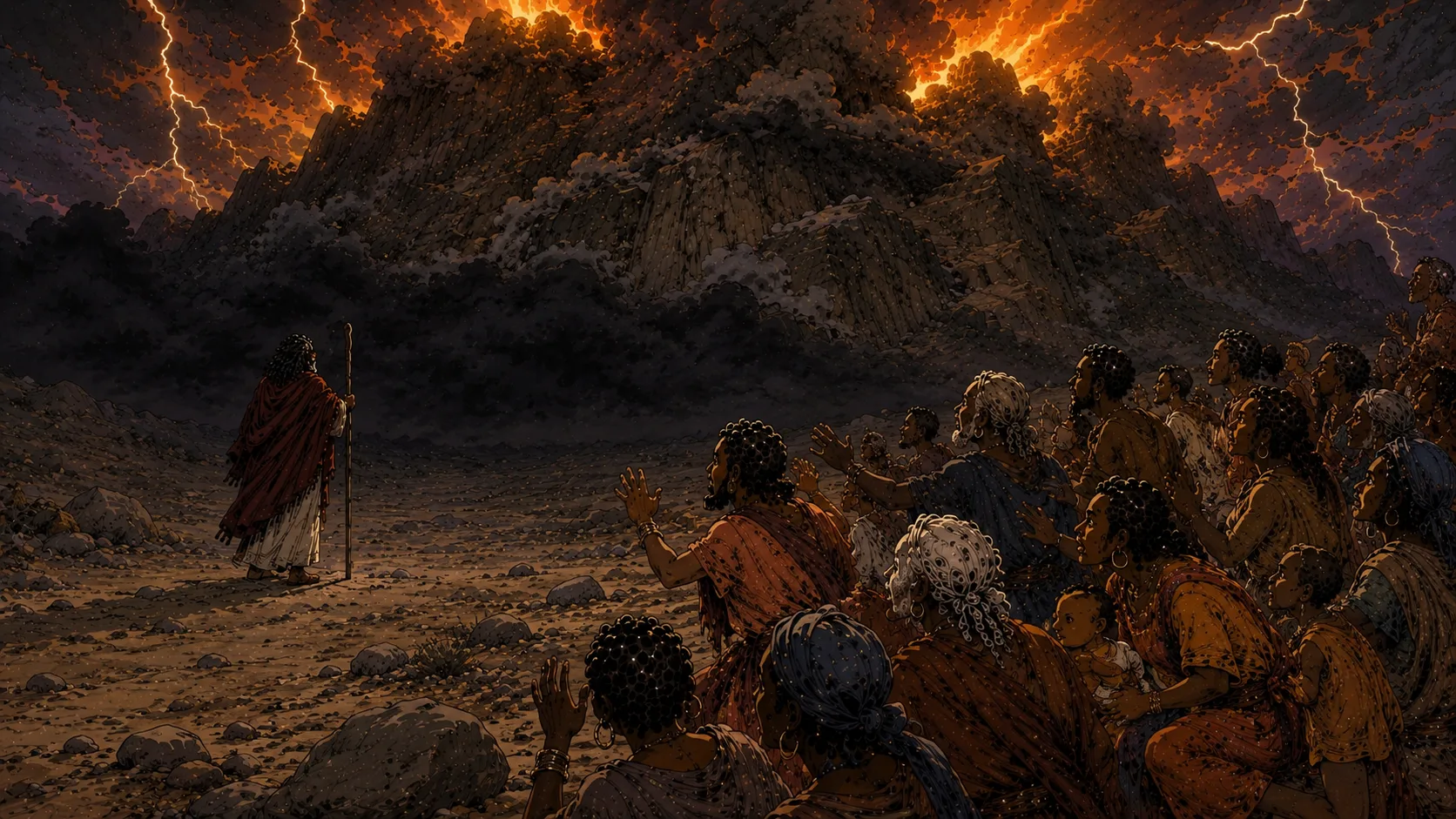
All the people see the thunder and lightning, the voice of the shofar, the mountain smoking — and they tremble. The Hebrew is precise: וַיַּרְא הָעָם וַיָּנֻעוּ — they saw and they reeled. Not metaphorical fear but physical trembling, the kind that moves through the whole body. They put distance between themselves and the mountain and come to Moses: You speak to us and we will hear. But do not let God speak to us, lest we die.
Moses answers: Do not fear. God came to test you — לְבַעֲבוּר נַסּוֹת אֶתְכֶם (l'va'avur nasot etchem) — so that his fear might be before your faces that you may not sin. His response holds a deliberate paradox: do not fear, so that the fear of God may remain with you. These are two different kinds of fear. The first is paralyzing terror — the kind that drives you away. Moses says that fear has no place here. The second is יִרְאַת אֱלֹהִים (yirat Elohim), the reverent awe of one who has stood in the presence of the Holy. That awe is not weakness; it is wisdom. It is the recognition of what the people have just encountered, carried forward as a restraint against every form of sin.
Then, in a single sentence, the scene resolves into its permanent image: the people stood far off, and Moses drew near to the thick darkness where God was. Two subjects. Two opposite directions of movement. Israel retreats. Moses advances. The same fire, the same cloud, the same mountain — but two entirely different responses, each appropriate to its particular calling. Moses does not condemn the people for standing back. Their retreat becomes the condition of Israel's future: from this moment, every law, every statute, every ordinance of the covenant comes through Moses as mediator. The people's choice here shapes the structure of Israelite religion permanently.
This is also the founding scene of the Hebrew concept of prophecy. The prophet is the one who draws near on behalf of those who cannot — who stands in the araphel so the community can receive the word without perishing in the direct encounter. Moses is not set apart because he has less fear than the people. He draws near because he has been called, and the summons is stronger than the trembling. His courage is not the absence of shaking; it is the willingness to keep walking toward the source while still shaking.
After this exchange, Moses returns carrying the first ordinances — the laws following the Ten Words in Exodus 20–23, called the Book of the Covenant. The people will later hear these read aloud and will agree to them. But the architecture of mediation is now set in permanent form: the whole people heard YHWH directly once, at Sinai, and once only. Everything that follows comes through the one who walked into the thick darkness where God was.