Moses turns and descends from the mountain with the two tablets of the testimony in his hands. The text pauses on the tablets themselves: they were inscribed on both sides, on this side and on that side they were written (32:15). There is no blank space, no margin, no room for human addition. They are finished works — complete, total, the entirety of the divine word in portable form. Moses carries what cannot be improved upon down a mountain that has already been betrayed. He does not yet know the full extent of what he will see, though YHWH told him on the mountain (32:7–10). He knows, and he still descends carrying the covenant toward the people who have broken it.
Joshua has been waiting on the slope, and Joshua hears the noise rising from the camp below. He names it war: there is the sound of war in the camp. Moses corrects him with precision. It is not the sound of victory shouting — עֲנוֹת גְּבוּרָה — and not the sound of defeat shouting — עֲנוֹת חֲלוּשָׁה. It is the sound of singing he hears. Moses has heard YHWH speak from fire and cloud; he knows what battle sounds like and what it does not. What Joshua mistakes for combat, Moses recognizes as something more devastating: a people at ease, celebrating, worshipping. The singing carries its own weight of judgment. They are not at war. They are content.
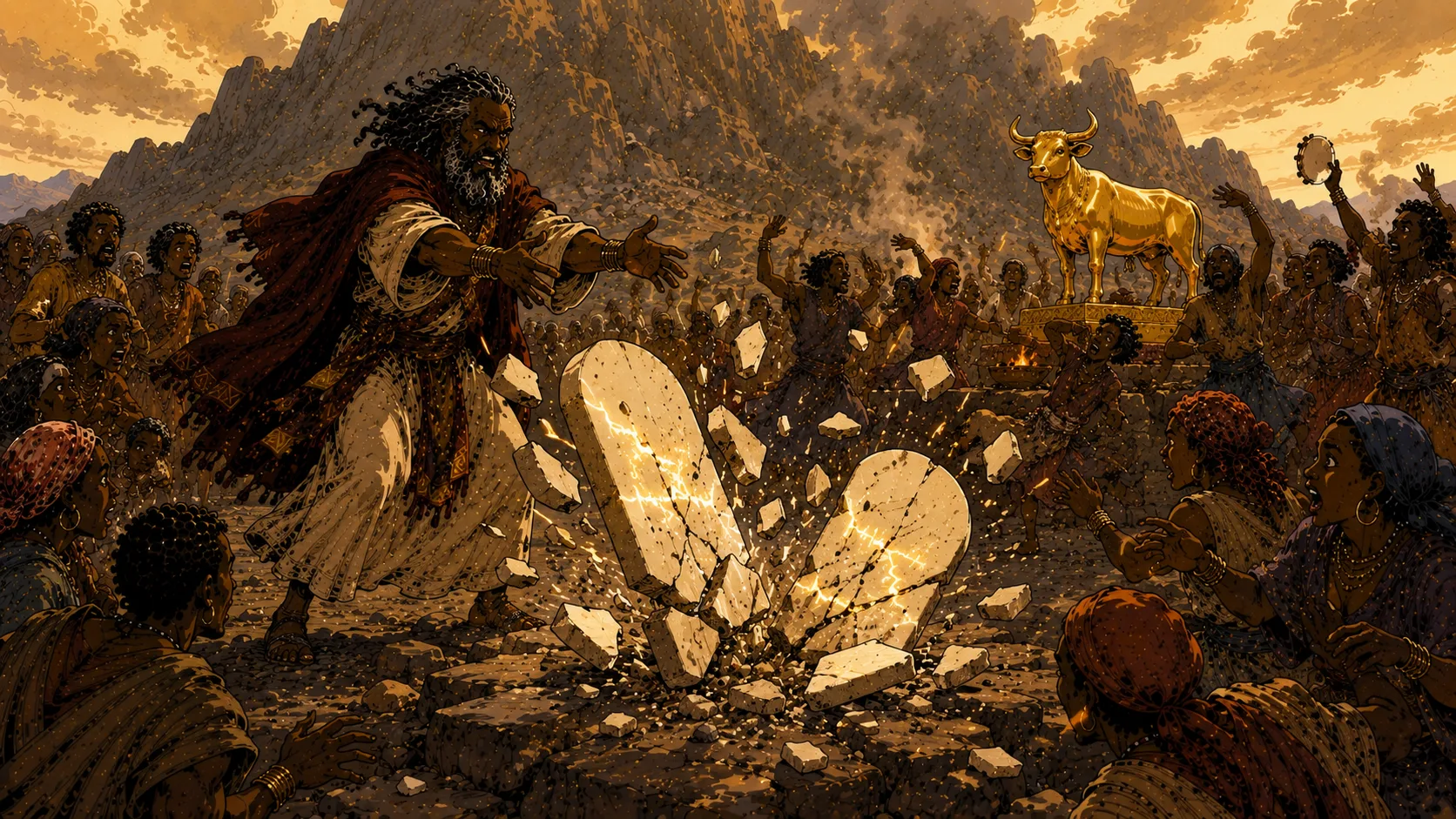
Then Moses approaches the camp and sees. The Hebrew sequence is compressed and exact: וַיַּרְא אֶת-הָעֵגֶל וּמְחֹלֹת — and he saw the calf and the dances. The conjunction joins them as a single image: the idol and the celebration exist together, inseparable. Moses has known about the calf since YHWH described it on the mountain. But knowing and seeing are not the same. The tablets are still in his hands when his anger burns. He has carried the covenant of YHWH all the way down — and now he sees, with his own eyes, what the covenant has been exchanged for.
וַיַּשְׁלֵךְ מִיָּדָו אֶת-הַלֻּחֹת וַיְשַׁבֵּר אֹתָם תַּחַת הָהָר — he threw the tablets from his hands and shattered them at the foot of the mountain. The act is not accident and not loss of control. He throws them; he shatters them. The same place — the foot of the mountain, תַּחַת הָהָר — where the covenant was ratified with blood, where the people declared נַעֲשֶׂה וְנִשְׁמָע, is now the place where the covenant document is destroyed. Moses enacts visibly what Israel has already done spiritually: a broken covenant is witnessed by a broken testimony. Later tradition records that the Holy One himself acknowledged the act — "You did well to break them." The shattering is not failure. It is truth.
What follows is equally deliberate. Moses takes the calf they have made, burns it in the fire, grinds it to fine powder, scatters the powder on the water, and makes the people of Israel drink it. The gold that was gathered from the necks of their wives and children — the gold that came from Egypt, the plunder of their deliverance — is burned, pulverized, dissolved, consumed. The idol passes through the bodies of its worshippers. It cannot be preserved. It cannot be displayed. It cannot remain as an artifact of devotion. Israel drinks the evidence of what they have done. There is no record that the water tasted bitter, but its weight was carried in every body that swallowed it.