YHWH speaks to Moses in the aftermath of the calf. He will keep his promise — he will send Israel to Canaan, he will drive out the inhabitants — but he will not go in their midst. לֹא אֶעֱלֶה בְּקִרְבְּךָ — I will not go up in your midst. The reason he gives is the same thing Moses will say in his intercession: Israel is עַם-קְשֵׁה-עֹרֶף, a stiff-necked people. If YHWH were to travel among them for even a single moment, he might consume them. The holy and the profane cannot share the same space without destruction. The offer of the angel is real — it will get Israel where they are going — but it is not presence. And Israel, apparently, understands the difference immediately.
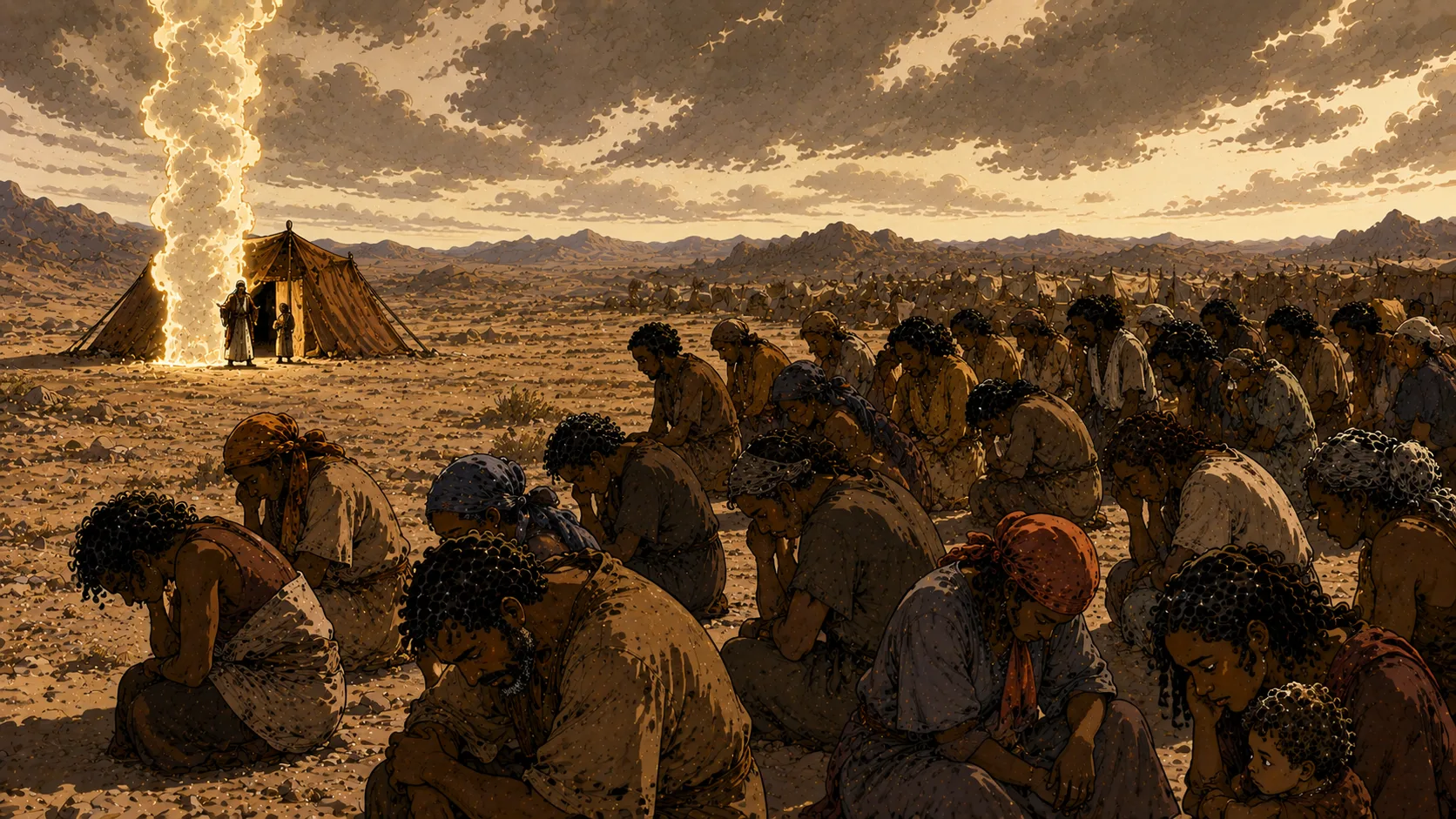
When the people hear this bad news — this evil word — they mourn. They do not argue or bargain. They put off their ornaments. YHWH had said: וְעַתָּה הוֹרֵד עֶדְיְךָ מֵעָלֶיךָ — now take off your ornaments from yourself. The ornaments were part of the gold that came from Egypt — the same gold from which the calf was made. By stripping them off at Horeb and not putting them back on, Israel participates in the reckoning. The gold that was liberation-plunder and became idol-material is now surrendered as a sign of grief. From Horeb onward, Israel goes without their ornaments.
Moses pitches a tent outside the camp, far from the camp, and calls it the Tent of Meeting — אֹהֶל מוֹעֵד. This is not the Mishkan, which has not yet been built. It is a provisional meeting place, erected in the crisis of divine withdrawal, set at a distance from the defiled camp. Anyone who seeks YHWH goes out to it. The distance is the theology: the presence that cannot safely be in the camp is available, but only at the boundary, only at the edge, only to those who deliberately go out to find it. Moses goes and the people watch. Each time he walks to the tent, every man stands at his tent door and watches until Moses enters.
When Moses enters the tent, the pillar of cloud descends and stands at the door. All the people see it — כָּל-הָעָם רָאוּ — and each man worships at his tent door. The scene has a reversal embedded in it: when Moses was on the mountain, the people were below, impatient, making a calf. Now Moses goes to the edge of the camp to meet YHWH, and the people watch from their doorways with reverence. They are no longer celebrating what they made. They are worshipping at the sight of what has descended. The crisis has produced something the covenant inauguration alone did not: the people as witnesses of divine arrival, watching in stillness from a distance, each in his own doorway.
YHWH speaks to Moses face to face — פָּנִים אֶל-פָּנִים — as a man speaks to his neighbor. The comparison is extraordinary. The most intimate form of human conversation — direct, unhidden, reciprocal — is used to describe what happens in the tent. The same chapter will say that no man can see God's face and live (33:20). The paradox is not contradiction; it is depth. Seeing the face of God in the consuming, unmediated sense is death; speaking face to face in this provisional, covenantal sense is the closest approach available to a human being. Moses is at the maximum of what is possible between creature and Creator. And then he returns to the camp. Joshua son of Nun, Moses' young attendant, does not depart from the tent. He stays where the cloud was.