This article is a continuation of Were the Irish Black? What 1847 Ship Manifests and the Hebrew Word Admoni Tell Us About Esau. That piece established that Irish immigrants were officially recorded as swarthy, dark, and Black in American ship manifests in 1847 — and that the category shifted within a single lifetime. This article picks up the question the Admoni article left open: what happened to the Irish people who were not just categorized as Black, but were treated as enslaved — before, during, and after the American experience? And what do the Hebrew prophets say about the islands where so many of them ended up?
I. Before 1847 — The Deportation Almost Nobody Teaches
Before Irish immigrants arrived at American ports in the 1840s and were recorded as swarthy and dark, another group of Irish and Scottish people had already crossed the Atlantic — not in immigrant ships, but in transport vessels, under armed guard, bound for the Caribbean.
In 1930, a Jesuit Catholic priest named Joseph J. Williams published a small book that asked a question almost no one had thought to ask: where did the "Black Irish" of Jamaica come from?
Williams had spent five years in Jamaica as a Catholic missionary — arriving in 1912, when the island had been under British colonial control for over two and a half centuries. What he found there opened an area of study that most historians had deliberately or carelessly closed: the deportation and enslavement of Irish and Scottish people to the Caribbean under Oliver Cromwell's regime in the 1650s — and the forgotten population their descendants had become.
Williams was a Fellow of the Royal Society of Arts, a member of the American Folklore Society, and held a Ph.D. in Ethnology. He had no ideological stake in what he found. He was a Jesuit Catholic priest doing field ethnology. And what sixteen years of combined field research and scholarship showed him pointed consistently in a direction that official history had buried under the colonial record the plantation owners wrote about themselves.
II. The Cromwellian Transportation — What Actually Happened
The documented historical record of what Cromwell's regime did to the Irish population is a matter of primary-source fact. The dates, the numbers, and the mechanism are all recorded.
1649 — The Conquest begins. Oliver Cromwell arrives in Ireland in August 1649. The sieges of Drogheda (September 1649) and Wexford (October 1649) become the defining atrocities — garrisons and portions of the civilian populations massacred. The conquest is largely complete by 1652.
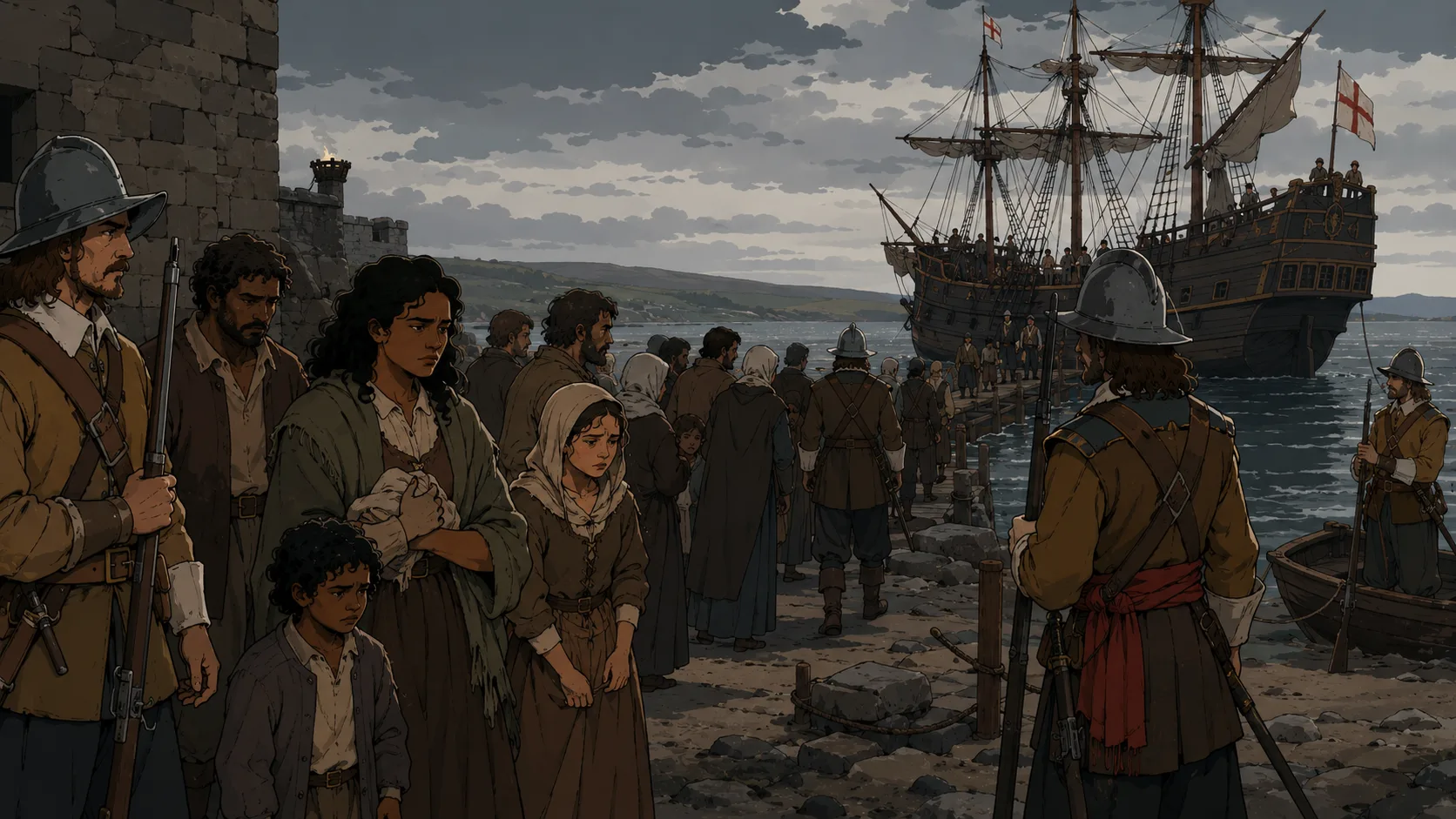
1652–1658 — The transportation begins. Under the Act for the Settlement of Ireland (1652), Cromwell's regime begins the systematic deportation of Irish men, women, and children to the Caribbean colonies — primarily Barbados and Jamaica. They were transported as indentured laborers in law, but the practical conditions were indistinguishable from slavery. The term the Irish used for it was to be Barbadosed — a verb, like a sentence pronounced on a person.
Estimates run between 50,000 and 100,000 people transported from Ireland to the Caribbean between 1652 and 1658. Scots taken prisoner after the Battle of Worcester (1651) — where Cromwell defeated the Scottish-Royalist army — were transported in substantial numbers as well.
What was taken from them was the same thing that has been taken from every scattered people this platform documents: their land (confiscated under the Cromwellian settlement), their religion (Catholic and Presbyterian practice suppressed), their language (Irish Gaelic prohibited), their names (anglicized in plantation records), their family structures (siblings and parents separated in transportation), and within a few generations, their origin story entirely.
The communities Williams found in Jamaica in 1912 had fragmentary memory of their Irish and Scottish ancestry at best. Their physical appearance still carried evidence of who their ancestors were. Their origin had been almost entirely overwritten by the colonial record.
III. What the Prophets Said About the Islands
Before examining what happened to these communities — in Jamaica and then in America — it is worth establishing what the Hebrew prophets had already said about where the scattered people of Israel would end up, and from where they would be gathered.
The Hebrew word is 'iyyim (אִיִּים) — the plural of 'iy. In the ancient Near East, the term designated any land reached by crossing water: islands proper, coastlands, and distant regions across the sea. The biblical writers used it to mean every far-off land surrounded or bounded by water. Of the 32 Old Testament passages using this word, 25 are concentrated in Isaiah, Jeremiah, and Ezekiel — the three prophets most focused on the scattering and gathering of Israel.
Three passages speak most directly to the question this article raises:
Isaiah 11:11 — The second recovery of Israel:
"And it shall come to pass in that day, that Yah shall set his hand again the second time to recover the remnant of his people, which shall be left, from Assyria, and from Egypt, and from Pathros, and from Cush, and from Elam, and from Shinar, and from Hamath, and from the islands of the sea."
The islands of the sea are named explicitly as one of the places from which the scattered remnant will be gathered in the second recovery. Not a region adjacent to the Levant. The islands of the sea — the farthest geographic reach of the exile. The text names them in the same breath as Assyria and Egypt and Cush, as a coordinate in the full global scope of the scattering and the gathering.
Isaiah 60:9 — Ships bringing Israel's sons from the islands:
"Surely the isles shall wait for me, and the ships of Tarshish first, to bring thy sons from far, their silver and their gold with them, unto the name of Yah thy God, and to the Holy One of Israel."
Israel's sons are on the islands. Ships bring them home. Read alongside Deuteronomy 28:68 — "Yah shall bring you into Egypt again with ships" — this is the prophetic arc completed: ships carried them away into captivity, ships bring them back into restoration. The same mechanism. The opposite direction. The islands are not outside the prophetic framework. They are inside it — named specifically as the place from which the sons come back.
Jeremiah 31:10 — The news of the gathering to be declared in the islands:
"Hear the word of Yah, O ye nations, and declare it in the isles afar off, and say, He that scattered Israel will gather him, and keep him, as a shepherd doth his flock."
The news is to be declared in the islands because Israel is in the islands. You do not send news to a place where the intended audience is not. Jeremiah names the islands as the geographic destination of the declaration precisely because the scattered of Israel are there — in the isles afar off — waiting to hear that the one who scattered them will also gather them.
The Caribbean. The British Isles. Every island group the Atlantic slave trade and the Cromwellian transportation reached. These are not outside the prophetic geography. They are inside it — named by the prophets centuries before a European ship crossed the Atlantic.
IV. Williams' Documentation — What He Found in Jamaica
In Jamaica between 1912 and 1917, Williams documented a community whose origins had been nearly entirely erased. He then spent eleven further years tracing what he found back through the historical record, publishing the results in two companion volumes in 1930.
Whence the Black Irish of Jamaica documented the Irish and Scottish deportees and the mixed population their descendants had become — the Black Irish of Jamaica, people whose physical appearance reflected multiple ancestries, whose community memory preserved fragments of origin stories the official colonial record had erased, and whose photographs Williams included in the 1930 edition.
Hebrewisms of West Africa documented something Williams found on both sides of the Atlantic: Hebrew practices preserved in communities that could not have learned them from Christian missionaries, because the missionaries were the ones discovering them. Among the Ashanti — from whom many Jamaicans descended — he found dietary laws, purification rituals, Sabbath observance, calendrical practices, and naming patterns with documented parallels to ancient Israelite practice that predated any European contact.
The two books together tell a layered story: Israelite-descended communities carried Hebrew practices across West Africa through the North African corridor. The Atlantic slave trade took those communities to the Caribbean. The Cromwellian transportation added Irish and Scottish deportees to the same plantation system. The result — the community Williams was documenting in 1912 — was a population whose every layer of origin had been systematically removed from the record that the colonial power wrote about itself.
V. The American Chapter — From Slavery to the Wages of Whiteness
When the Admoni article opened with the 1847 ship manifests, it was documenting the arrival of a new wave of Irish and Scottish immigrants into a country that had already been shaped by 200 years of African enslavement. The Irish Famine immigrants arrived into a racial economy with a binary taxonomy — white and Black — and they arrived on the wrong side of it.
The labor competition. In Northern cities — New York, Boston, Philadelphia, Chicago — free Black Americans and Irish immigrants competed for the same unskilled labor: dockwork, domestic service, construction. The competition was real and bitter. Irish immigrants, who had their own experience of colonial subjugation in Ireland, often responded to that competition with organized violence rather than solidarity.
The Draft Riots of 1863. The most concentrated expression of this dynamic came in July 1863 in New York City, when the implementation of the Civil War draft — which allowed wealthy men to pay $300 to avoid conscription — ignited four days of riots in which Irish mobs attacked the offices of the draft, then turned on Black communities. The Colored Orphan Asylum on Fifth Avenue was burned to the ground. Black men, women, and children were hunted through the streets. At least 11 Black men were lynched. The death toll across the four days is estimated between 119 and 1,200, with Black New Yorkers suffering the most concentrated violence. It was the deadliest civil disturbance in American history.
The rioters were not defending Ireland. They were purchasing whiteness — using anti-Black violence as the currency of racial acceptance in a country that rewarded it.
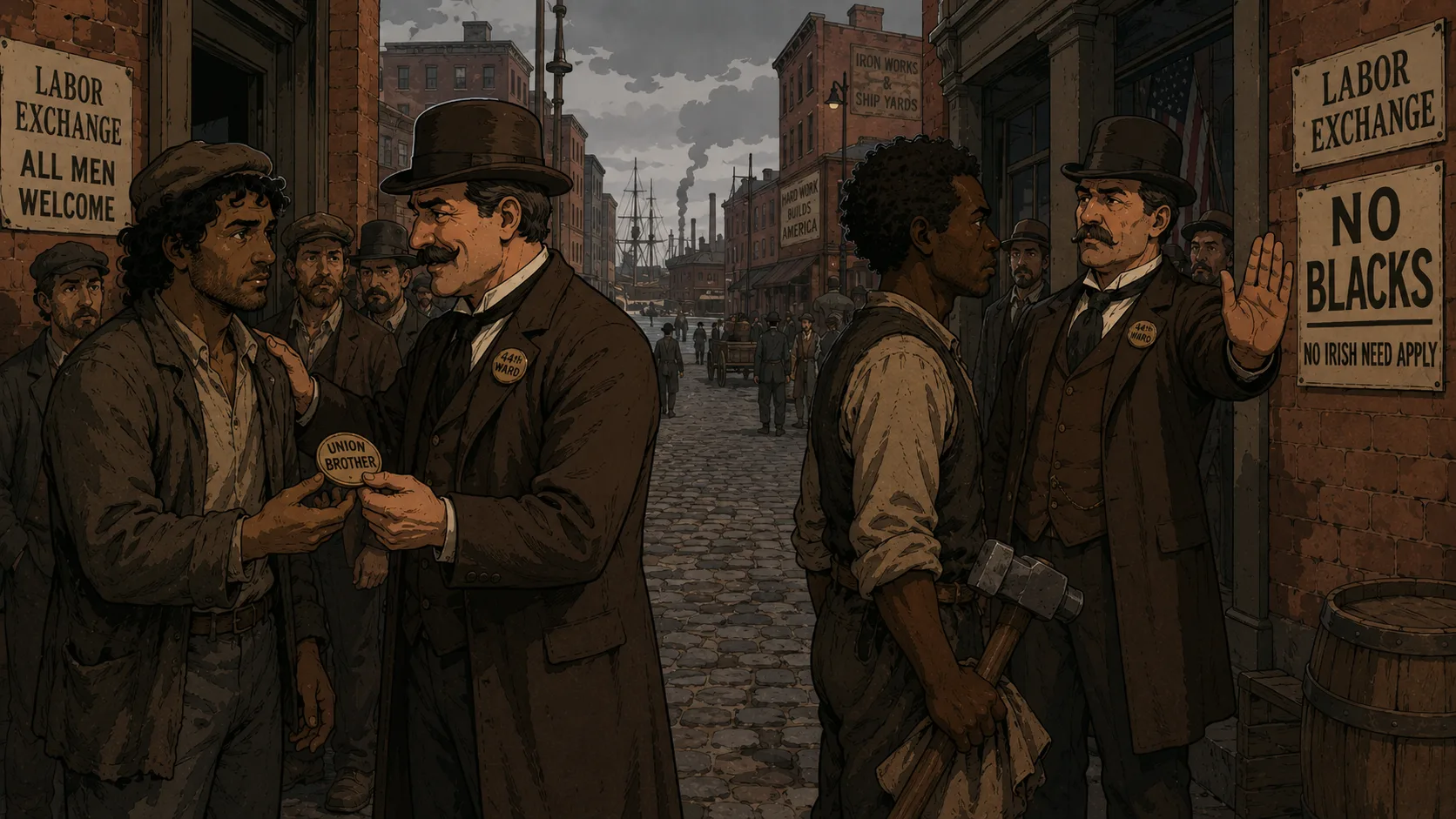
The wages of whiteness. David Roediger's 1991 study — the same source the Admoni article cited — traced how this pattern operated as a systematic social mechanism across the 19th century. Irish immigrants learned, rapidly, that the path to economic advancement and social acceptance in America ran through racial alignment with white power and racial opposition to Black Americans. Union membership, political patronage, police appointment, and neighborhood security all rewarded those who participated in the maintenance of the color line.
The wages were real. They were paid in anti-Black violence, political alignment with the Democratic Party's segregationist wing, and the systematic exclusion of Black workers from trades that Irish immigrants controlled. By the early 20th century, the Irish had paid enough of these wages to be admitted into the white category their grandparents had been explicitly excluded from.
Post-slavery to the Civil Rights era. The pattern continued after emancipation in forms that were less physically violent but structurally equivalent. Irish Catholic communities in Northern cities were among the most organized resistors to residential integration in the mid-20th century. Restrictive covenants, redlining, and white flight — the mechanisms that created and preserved segregated urban neighborhoods — were enforced in part through the political structures that Irish Democratic machines in cities like Boston, Chicago, and New York controlled.
The Boston school busing crisis (1974–1988) is the most extensively documented case. When Federal Judge Arthur Garrity ordered the desegregation of Boston public schools, the most violent resistance came from Irish Catholic neighborhoods — South Boston and Charlestown specifically. School buses carrying Black students were stoned. The images of white Bostonians attacking buses of Black children in the city that had been the heart of American abolitionism became one of the most shocking documents of post-Civil Rights America.
The irony that Roediger and Ignatiev both noted was precise: the communities most violently resistant to Black advancement in Boston in 1974 were descended from people who had been called swarthy and Black in the 1847 ship manifests. The same blood. The same lineage. Seventy-seven years between the manifest and the whiteness. Another generation to the riots.
The complexity — solidarity as well as conflict. The relationship between Irish American and Black American communities has never been only conflict. Some of the most prominent figures in the American labor movement and the early civil rights movement were Irish Catholic — figures who understood subjugation from their own history and chose solidarity over racial advantage. The longshoremen's unions in some cities maintained integrated workforces when other trades were exclusively white. Father James Groppi, a Milwaukee priest of Italian-Irish descent, marched with the NAACP open-housing marchers in 1967 through mobs that hurled bottles and racial slurs. The relationship has always been complicated — simultaneous solidarity and opposition, sometimes in the same community at the same moment.
Modern times — the rediscovery. In recent decades, a growing scholarly and popular movement has reclaimed the history of the Cromwellian transportation — pushing back against the notion that the Irish experience of forced deportation and colonial subjugation was categorically different from the African American experience of enslavement. The specific claim that Irish people were enslaved — rather than indentured — remains contested among historians, who note important legal differences between chattel slavery and indenture even when the practical conditions were similar. What is not contested is that tens of thousands of Irish and Scottish people were transported to the Caribbean against their will, that the conditions of their labor were brutal, and that their history has been systematically excluded from the mainstream account of the transatlantic slave trade.
The Black Irish identity movement — people of Irish descent who identify with their darker-complected heritage and its colonial history — has grown in Ireland, Jamaica, and the Irish diaspora globally. Williams' 1930 book, available in full through the Internet Archive, has found a new audience among people trying to understand a history that official records buried.
VI. The Hebrew Practices in Jamaica — The Other Thread
Williams documented something in Jamaica beyond the Black Irish deportee population. He documented Hebrew practices among the Jamaican population more broadly — practices whose African origin he traced back to the Ashanti in Hebrewisms of West Africa, but which he also found persisting independently in Jamaican communities in the early 20th century.
These practices — dietary restrictions consistent with Torah food laws, seventh-day Sabbath observance, purification customs, calendrical observances paralleling the Hebrew appointed times, and oral traditions of an ancient origin connected to the people of Israel — were present in Jamaica across multiple community streams. They predated any organized Hebrew Israelite movement. They could not have been derived from Christian missionary teaching.
What Williams found in Jamaica in 1912 was a community where the Atlantic slave trade had concentrated, in one island, populations from multiple directions of the scattering — West African Israelite-descended communities carrying Hebrew practice, Ashanti communities with documented parallels to ancient Israelite tradition, Irish and Scottish deportees with their own fragmented history of colonial subjugation, and the mixed-ancestry communities that resulted from their forced proximity under the plantation system.
The Deuteronomy 28 pattern had brought multiple streams of the scattered into the same geographic location. And some of what survived in that community carried evidence of origins that the colonial record had done everything it could to erase.
VII. What Williams Represents for the Platform
Joseph J. Williams is cited in this article and in the companion article The 1747 Map That Called It the Kingdom of Judah for a specific reason that goes beyond the content of his documentation: he is a hostile witness.
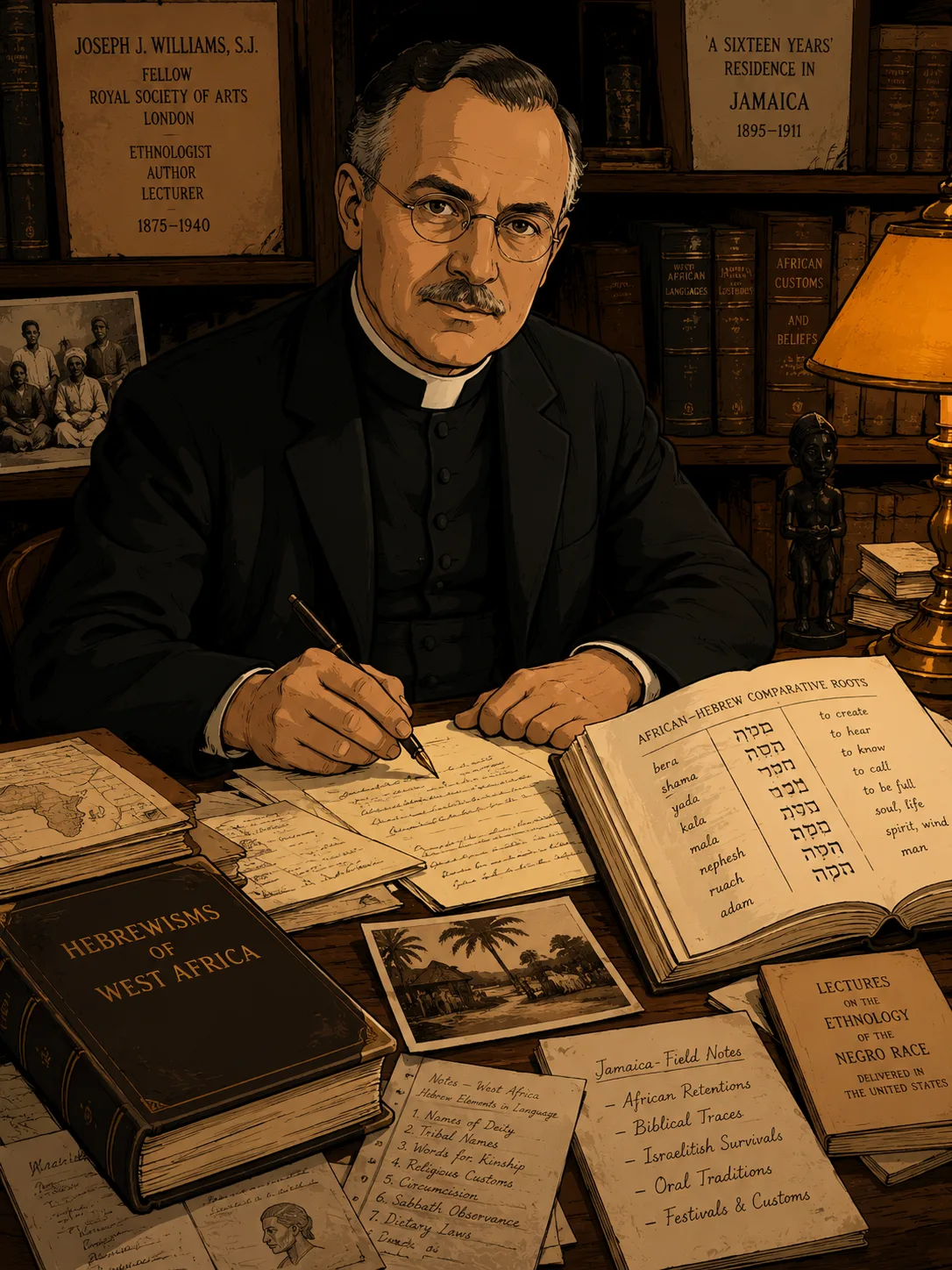
He was a Jesuit Catholic priest. His religious tradition taught that the church had superseded Israel as the covenant people — a position this platform does not share. He had no theological or ideological stake in confirming Israelite heritage in West Africa or the Caribbean. Sixteen years of field research and scholarship, across Jamaica and West Africa, consistently pointed toward Hebrew practice preserved in communities the official historical record described only as African slaves and Irish laborers.
When a witness with no interest in confirming a conclusion confirms it anyway, that confirmation carries weight that an advocate's testimony cannot.
The full text of Whence the Black Irish of Jamaica (1930) and Hebrewisms of West Africa (1930) are available through the Internet Archive at no cost. Both are primary sources of genuine scholarly merit.
VIII. The Pattern — Where All of This Fits
The story this article has traced runs from the Cromwellian transportation of the 1650s through the American racial economy of the 19th and 20th centuries to Williams' documentation in 1912 Jamaica. What holds it together is the same pattern this platform documents across every exile wave and every imperial conquest:
A conquering power identifies a population by ethnic, religious, or genealogical identity. It strips them of their land and their legal standing. It removes them by force — by ships. It prohibits the continuation of their practice, their language, and their identity. It assigns them to labor in service of the conquering power. And within a generation or two, the population's origin story is erased from the record the conquering power writes about itself.
Psalm 83:4 named the intention: "Come, and let us cut them off from being a nation; that the name of Israel may be no more in remembrance." The Cromwellian transportation did not target an Israelite community by that name. It targeted an Irish Catholic and Scottish Presbyterian population. But the mechanism and the result were identical to the pattern Moshe named in Deuteronomy 28.
And the prophets named where those communities would end up: the islands of the sea. Isaiah 11:11 names the islands as one of the gathering points in the second recovery of Israel. Isaiah 60:9 names ships bringing Israel's sons home from the islands — the same ships that carried them there. Jeremiah 31:10 names the islands as the place where the news of Israel's gathering must be declared — because Israel is there.
The Caribbean. The British Isles. The islands the Cromwellian transportation and the Atlantic slave trade reached. The prophets named them. The exile confirmed them. The gathering is still coming.
IX. The Call
The story of the Black Irish of Jamaica is one thread in a much larger pattern. The Admoni article showed that complexion categories are socially constructed — that the same Irish bloodline could be called swarthy and Black in 1847 and unambiguously white by 1924. This article has shown what was happening to Irish and Scottish people before 1847, when the transportation was the mechanism rather than the ship manifest: Cromwell's deportation, the Caribbean plantation system, the mixed communities of Jamaica, and the Hebrew practices Williams found preserved there.
And it has shown what happened after 1847, when Irish immigrants in America chose whiteness over solidarity — at a documented, violent, historical cost — and what that choice produced across the 19th and 20th centuries.
This article speaks to three groups.
To the Israelite — the bloodline descendant of Yaakov's twelve tribes, wherever the exile carried you: Isaiah 11:11 names the islands as a gathering point. Isaiah 60:9 names ships as the mechanism of the return. Jeremiah 31:10 says the news of your gathering is to be declared in the isles afar off. You are not outside the prophetic framework. You are inside it — specifically named as being where you are, and specifically promised to be gathered from where you are. If the question is who you are — Who Are the Israelites? goes there directly. The commandments are the path back to the covenant. The final one — Do Not Forsake the Covenant — names what Deuteronomy 29 says the nations will ask when they see Israel scattered, and what Deuteronomy 30 says comes after. All 613 are at hebroni.com/en/commandments/.
To the Irish and Scottish diaspora — whose ancestors were called Black in American ship manifests, whose history includes both the colonial subjugation of Ireland and the violent pursuit of whiteness in America, whose bloodline carries the Cromwellian transportation in its background: the full story of your history includes chapters that the official record erased. Williams found them in Jamaica in 1912. The Admoni article found them in the 1847 ship manifests. This article has tried to connect the pieces the official history left disconnected.
To the Christian — who has been following the Messiah of Israel in the tradition of the same European powers that ran the deportations this article documents: the faith you follow was born among the Bani Isra'il whose history these articles trace. Return to the Hebrew roots is return to what the first believers practiced before Cromwell, before Constantine, before any empire rewrote the record.
The commandments are the road.
A Note on Method
This article documents the historical record of the Cromwellian transportation (1652–1658) through primary-source historical accounts and Williams' 1930 scholarly work. The Irish experience of forced transportation is documented as indenture in law — with important distinctions from chattel slavery noted honestly — while acknowledging that the practical conditions of transportation and plantation labor were brutal and the origin story was systematically erased. The Irish American involvement in anti-Black violence (the 1863 Draft Riots, the Boston busing crisis) is documented through established historical scholarship, including Ignatiev's How the Irish Became White, Roediger's The Wages of Whiteness, and primary-source accounts. The relationship between Irish American and Black American communities is presented with the complexity it deserves — both solidarity and conflict documented rather than either one erased. Williams is cited as a hostile witness — a Jesuit Catholic priest whose findings pointed toward Hebrew practice in West African and Jamaican communities independently of any Hebrew Israelite advocacy. The three island scriptures (Isaiah 11:11, Isaiah 60:9, Jeremiah 31:10) are quoted precisely and their relevance to the Caribbean context explained without overclaiming specific identification of any community.
Companion Reading
- Were the Irish Black? What 1847 Ship Manifests and the Hebrew Word Admoni Tell Us About Esau — the article this piece continues
- The 1747 Map That Called It the Kingdom of Judah — the West African cartographic and historiographic evidence base
- Deuteronomy 28: The Curses, the Prophecy, and the Way Back — the pattern this article documents historically
- Who Are the Israelites? — the foundational context
Sources
- Joseph J. Williams, S.J., Whence the Black Irish of Jamaica (Dial Press, 1930) — Internet Archive
- Joseph J. Williams, S.J., Hebrewisms of West Africa: From the Nile to the Niger (Dial Press, 1930)
- Noel Ignatiev, How the Irish Became White (Routledge, 1995) — Internet Archive
- David R. Roediger, The Wages of Whiteness (Verso, 1991) — Internet Archive
- Matthew Frye Jacobson, Whiteness of a Different Color (Harvard University Press, 1998)
- Act for the Settlement of Ireland (1652) — primary source
- Isaiah 11:11; Isaiah 60:9; Jeremiah 31:10 — Hebroni Nevi'im Reader
✡ The Commandments Are the Road Back
The same covenant the prophets spoke from — every one of the 613 commandments given at Sinai, numbered, explained, and linked to their biblical source.
The 613 Commandments Read the Torah