Shemot — Exodus — opens with a disturbing sentence: "A new king arose over Egypt who did not know Yosef." Four hundred years after the descent of seventy souls, a new Pharaoh looked at the Israelites and saw a threat. They were too many. Too strong. He put taskmasters over them. Vaya'anehu b'sivlotam — "and they afflicted them with their burdens." Mortar, bricks, field labor — hard service in every form. And the more they were afflicted, the more they multiplied. Pharaoh's anxiety deepened. He ordered the Hebrew midwives to kill every boy born to a Hebrew woman. The midwives feared God and did not obey. Pharaoh escalated: every newborn Hebrew son was to be thrown into the Nile.
The environment of Moses' birth was one of systematic genocide. The superpower of the ancient world had decided that a slave population had grown too dangerous to live. Into this environment, a Levite woman gave birth to a son, hid him for three months, and then placed him in a waterproof basket among the reeds of the Nile. His sister watched from a distance. Pharaoh's daughter came to bathe, found the basket, heard the baby cry, had compassion. The sister offered to find a Hebrew nurse. The mother nursed her own son, in Pharaoh's palace, paid by Pharaoh's daughter, until the boy was old enough to become the grandson of the man who had ordered his death.
Moshe grew up in Pharaoh's palace and went out one day to see his brothers' burdens. He saw an Egyptian striking a Hebrew. He looked both ways, saw no one, and killed the Egyptian. The next day he tried to stop two Hebrews fighting; one of them said, "Who made you prince and judge over us? Do you mean to kill me as you killed the Egyptian?" The secret was out. Pharaoh sought to kill him. Moshe fled to Midian, where he sat by a well and helped Jethro's daughters water their flocks, and eventually married Tzipporah and had a son.
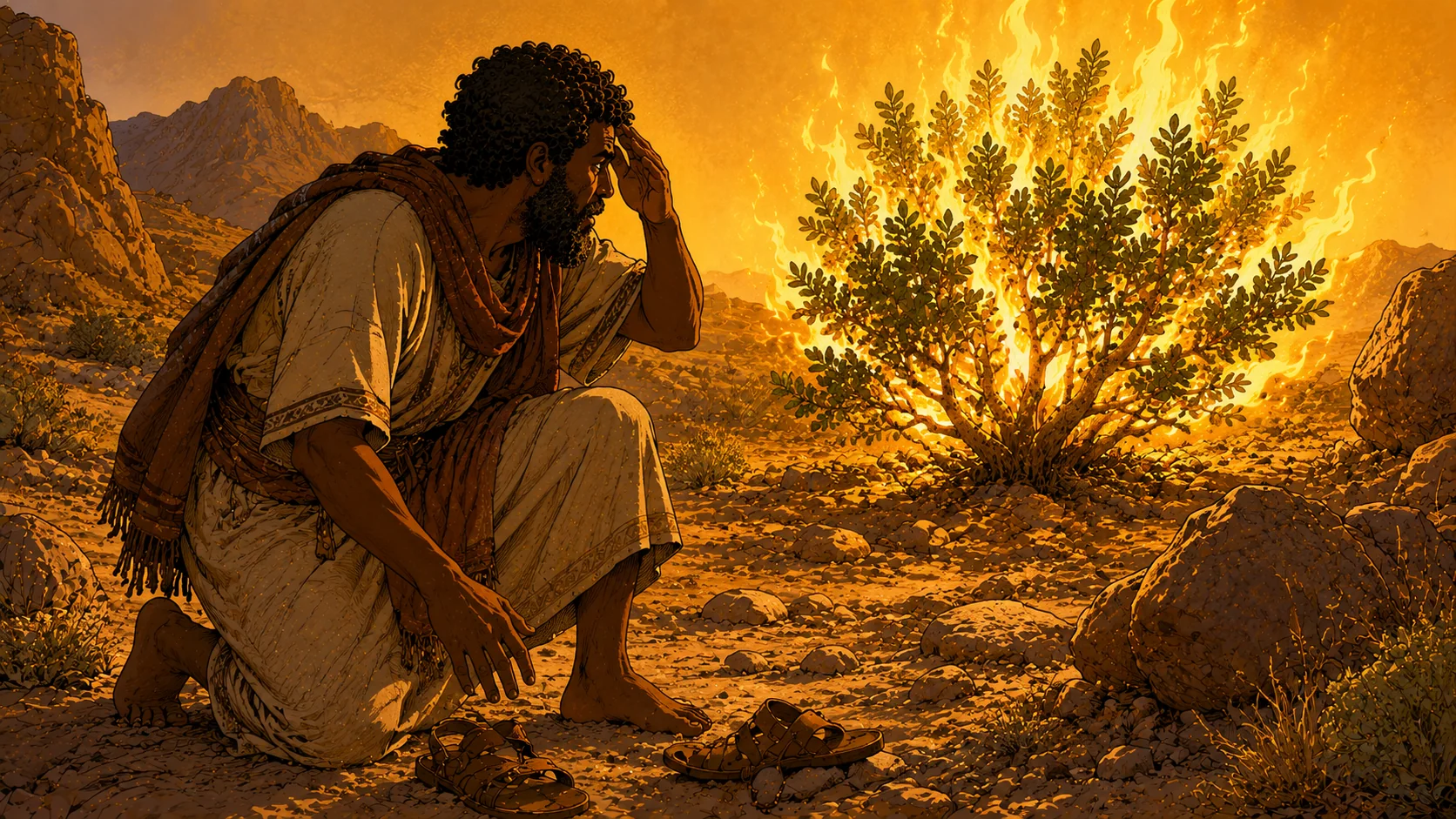
Forty years passed. Then he was tending Jethro's flock at Horev — the mountain of God — and he saw a bush burning that was not consumed. He turned aside to look, and God called to him from the bush: "Moshe! Moshe!" He answered, "Here I am." "Remove your sandals from your feet — the place on which you stand is holy ground." Then the commission: go to Pharaoh, bring my people out of Egypt. Moshe had objections: who am I? what is your name? what if they don't believe me? I am not a man of words. God answered every objection. He gave him signs. He gave him his name. He gave him his brother Aharon as spokesman. And Moshe went.
The confrontation with Pharaoh was not a negotiation. It was a demonstration — a systematic dismantling of the Egyptian pantheon, plague by plague, targeting the gods each one was meant to mock. Water to blood: the Nile, Egypt's lifeblood and a god in its own right. Frogs, lice, flies, livestock disease, boils, hail, locusts, darkness — each escalation a statement that the God of the Hebrews controlled what Egypt worshipped. Pharaoh hardened his heart after each plague. He would let them go, then withdraw. Vayechazek Elohim et lev Paroh — "and God strengthened Pharaoh's heart." The hardening was not divine manipulation. It was divine permission: Pharaoh was allowed to become fully what he already chose to be.
The tenth plague was different in kind. Not a display of power over nature. A death that entered every house in Egypt that was not marked. The blood of a lamb on the doorposts and lintel was the sign: the destroyer would pass over. Every firstborn in Egypt — human and animal — died at midnight. The firstborn of the prisoner in the dungeon. The firstborn of Pharaoh himself. A great cry rose from Egypt such as there had never been and never would be again. And Pharaoh called for Moshe at night: "Go. Go serve your God. And bless me also."
The Exodus was not Israel escaping Egypt. It was Israel being redeemed — bought back — from a power that had no right to keep them. The blood on the doorposts was the price of the purchase.
Six hundred thousand men on foot, plus women and children, plus a mixed multitude — and Pharaoh changed his mind one more time. He sent his chariots after them. The Israelites, camped by the sea, saw the Egyptian army coming and panicked. Moshe said: "Stand still and see the salvation of the LORD." The pillar of cloud moved from before them to behind them, separating Israel from Egypt through the night. Moshe stretched out his hand. The sea split. They walked through on dry ground, with a wall of water on their right and on their left.
The Egyptians followed. At the morning watch, the LORD looked down on the Egyptian camp and threw it into panic. The chariot wheels came off. The Egyptians cried: "Let us flee from before Israel, for the LORD fights for them!" Moshe stretched out his hand again. The sea returned. Not one of them survived. Israel saw the Egyptians dead on the shore. The Torah says: Vayar Yisrael et hayad hagedolah — "and Israel saw the great hand" — and they believed in the LORD and in His servant Moshe.
Then Moshe sang. Then Miriam took a timbrel and all the women went out after her with timbrels and dancing, and she answered them: "Sing to the LORD, for He is highly exalted — the horse and its rider He has thrown into the sea." The first song recorded in the Torah was sung at the shore of a sea, by a freed people, who had just watched everything they had feared become powerless. The Exodus arc ends there — at the edge of the wilderness, with the song still in the air, and everything that comes next still ahead of them.