Ya'akov loved Yosef more than any of his other sons — the son of his old age, the son of Rachel. He gave him a coat of many colors, or perhaps a coat with long sleeves: the mark of a son who did not labor in the field. Yosef dreamed. His sheaves rose and his brothers' sheaves bowed down. The sun and moon and eleven stars bowed to him. He told his brothers. He told his father. Even Ya'akov rebuked him for the second dream. But the Torah adds a quiet line: "and his brothers were jealous of him — and his father kept the matter in mind." The father recognized something the brothers could not tolerate.
The jealousy became a plan. When Yosef came to find his brothers in the fields of Dothan, they saw him from a distance and conspired to kill the dreamer. Reuven talked them back from murder — throw him in a pit, shed no blood. They stripped him of the coat and threw him in. Then Yishmael merchants passed on the road to Egypt. Yehudah suggested they sell him rather than kill him. Twenty pieces of silver. They dipped the coat in goat's blood and brought it to their father: "Is this your son's coat?" Ya'akov tore his clothes and mourned for many days and refused to be comforted.
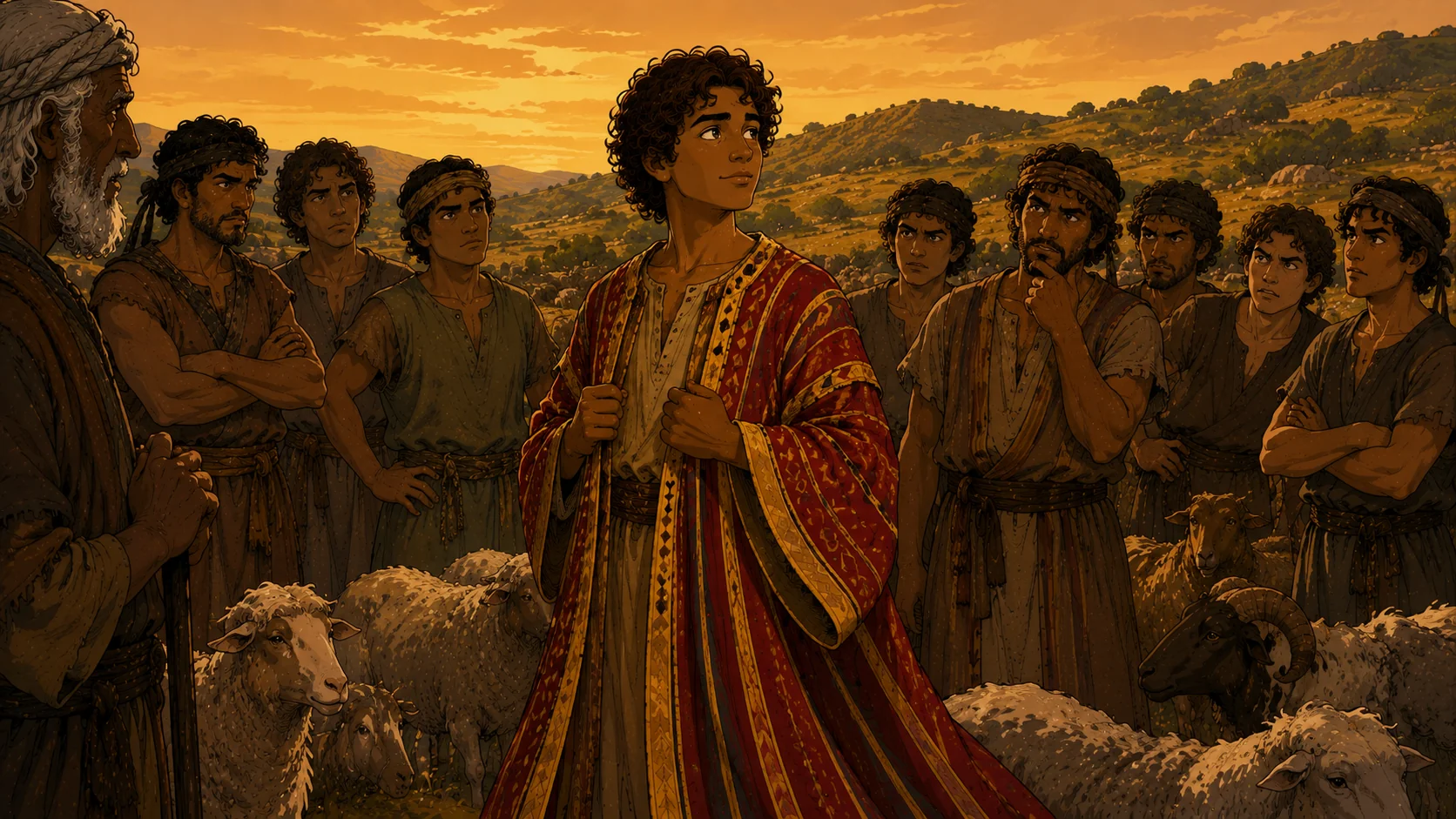 Bereshit 37:2–4 — Ya'akov gave Yosef a coat of many colors, a mark of favor. His brothers saw it and could not speak peaceably to him.
Yosef was sold to Potiphar, captain of Pharaoh's guard. The Torah says something striking: "The LORD was with Yosef, and he was a successful man." Not eventually successful — successful now, in slavery, in a foreign household, under a foreign master. Potiphar noticed. He put Yosef over his entire house. Then Potiphar's wife noticed too. She pursued him repeatedly; he refused repeatedly — "how could I do this great wickedness and sin against God?" One day she grabbed his garment as he fled. She kept the garment and accused him. He was thrown into prison.
In prison: "the LORD was with Yosef." The same phrase, the same pattern. He was put in charge of all the prisoners. Two of Pharaoh's officers were imprisoned with him — his chief butler and his chief baker — both troubled by dreams the same night. Yosef saw their downcast faces and asked: "Why are your faces troubled today?" He interpreted both: the butler restored in three days, the baker executed. Both came true exactly. The butler was restored and forgot Yosef. Two more years passed. Then Pharaoh dreamed — twice — and no one in all Egypt could interpret the dreams. The butler remembered the Hebrew in the dungeon.
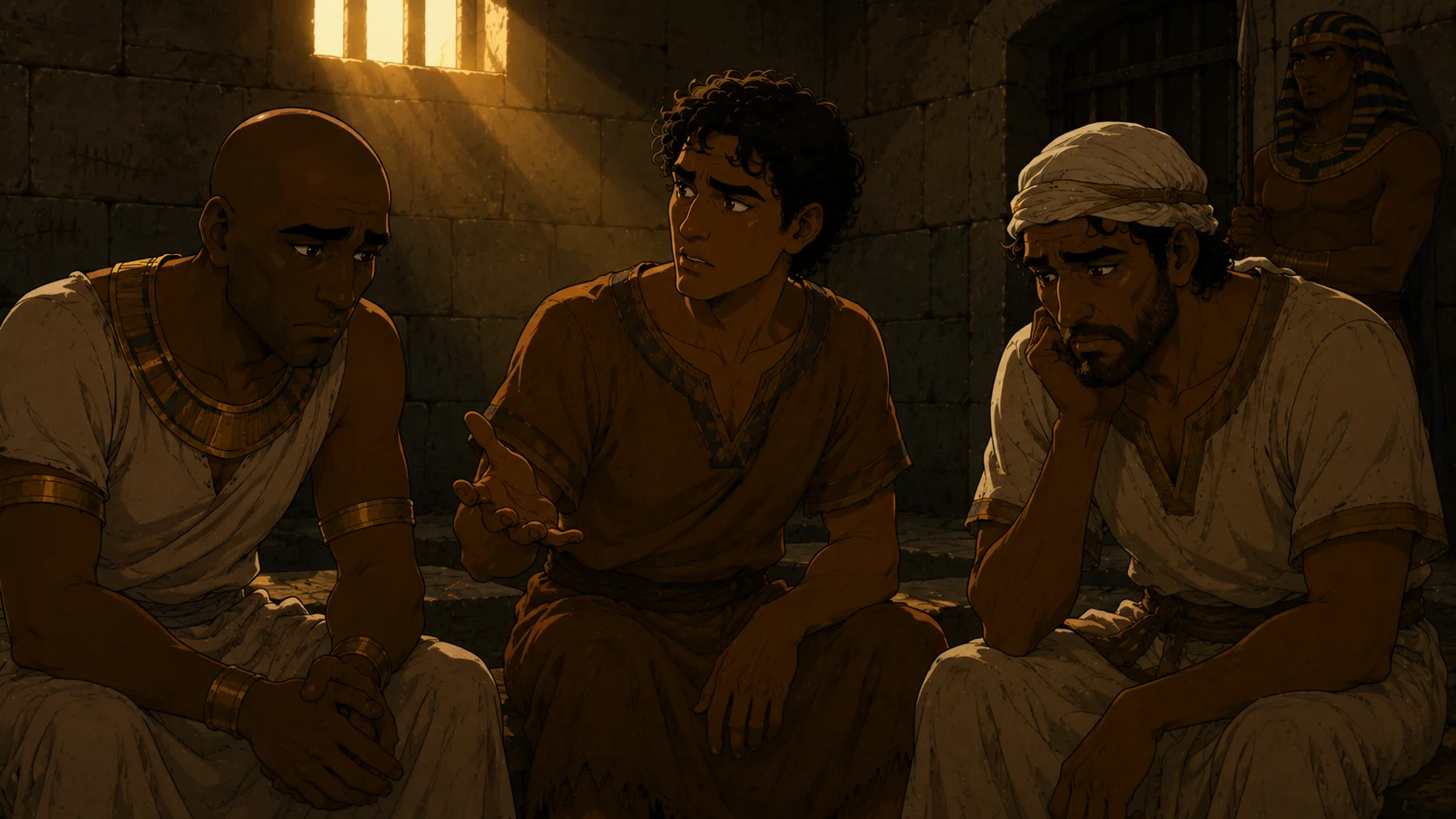 Bereshit 40:1–8 — Two of Pharaoh's officers, imprisoned with Yosef, each dreamed the same night. He saw their downcast faces: "Why are your faces troubled today?"
Yosef was brought before Pharaoh. He shaved, changed his clothes, and stood in the presence of the most powerful ruler in the known world. Pharaoh told him his dreams: seven fat cows swallowed by seven lean ones, seven full ears of grain swallowed by seven thin ones. Yosef did not hesitate. Seven years of plenty followed by seven years of severe famine. The repetition — two dreams with the same message — meant the thing was established by Elohim and would shortly come to pass. His counsel was immediate: appoint a wise and discerning man over Egypt, collect a fifth of all produce during the good years.
Pharaoh turned to his servants and asked: "Can we find a man like this, in whom is the spirit of God?" He put Yosef over all Egypt. Only in the throne would Pharaoh be greater. Yosef received the signet ring, fine linen, a gold chain, a chariot, an Egyptian wife, and a new name. He was thirty years old, and he was second in command of the world's greatest empire — a position he had reached from a pit in Dothan, through a slave market, through a prison, in thirteen years of consecutive descents. The famine came exactly as foretold. People of every land came to Egypt to buy grain from Yosef.
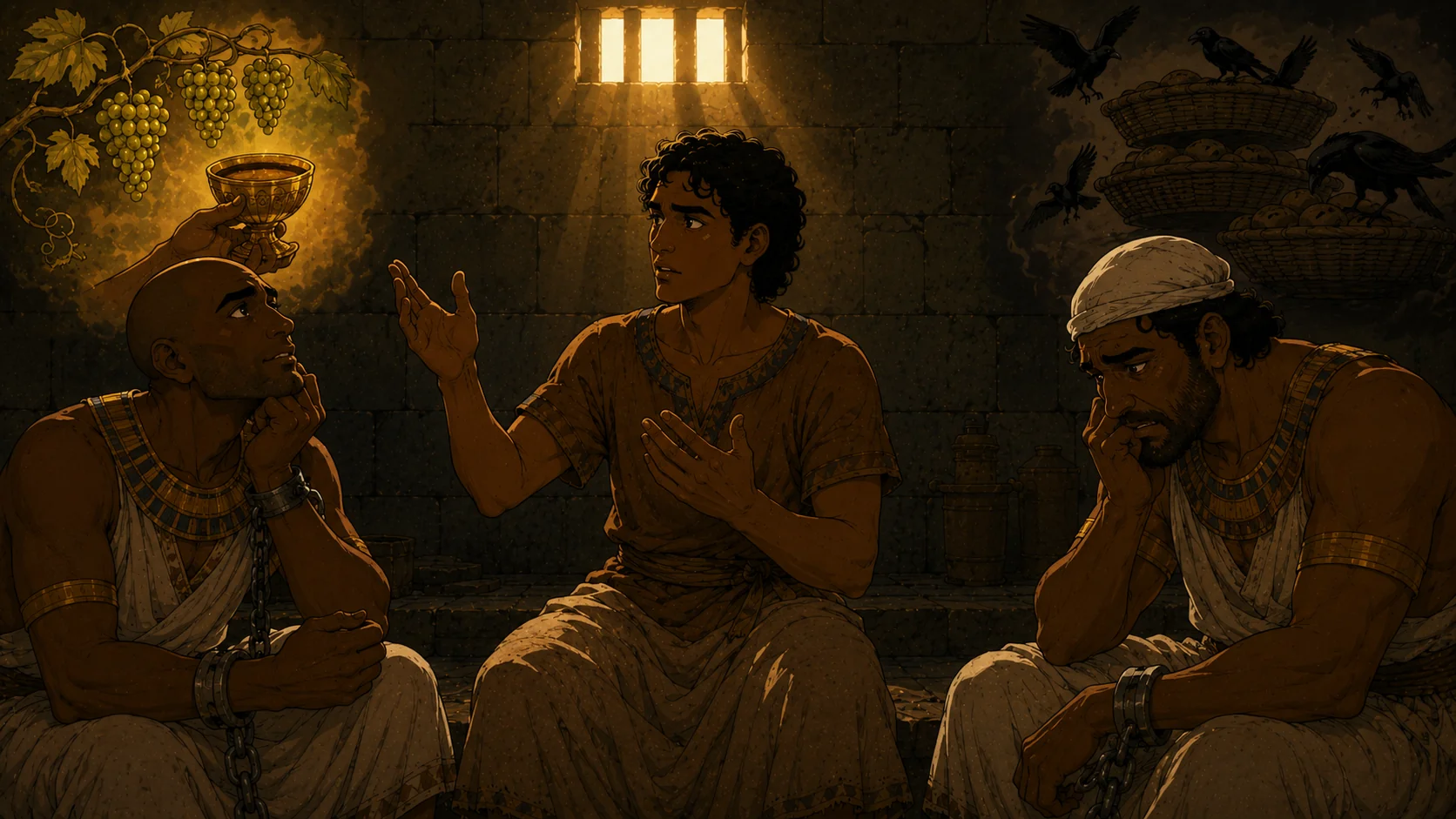 Bereshit 40:9–23 — Yosef listened to both dreams and spoke their meaning exactly: the butler restored in three days, the baker executed. Both came true.
Ya'akov sent ten of his sons to Egypt for grain. Binyamin, the youngest — Rachel's surviving son — he kept home. The brothers came and bowed before the viceroy of Egypt without recognizing him. Yosef recognized them immediately. He accused them of being spies, demanded they bring Binyamin, kept Shim'on as surety. When they returned with Binyamin, Yosef's emotions broke through: he had to leave the room and weep privately before he could return composed. He planted a silver cup in Binyamin's sack — a final test. Would they abandon the youngest, the way they had abandoned him? When the cup was found, Yehudah — who had suggested selling Yosef decades before — stood up and offered himself in Binyamin's place. His speech (Genesis 44:18-34) is among the most moving in the Torah.
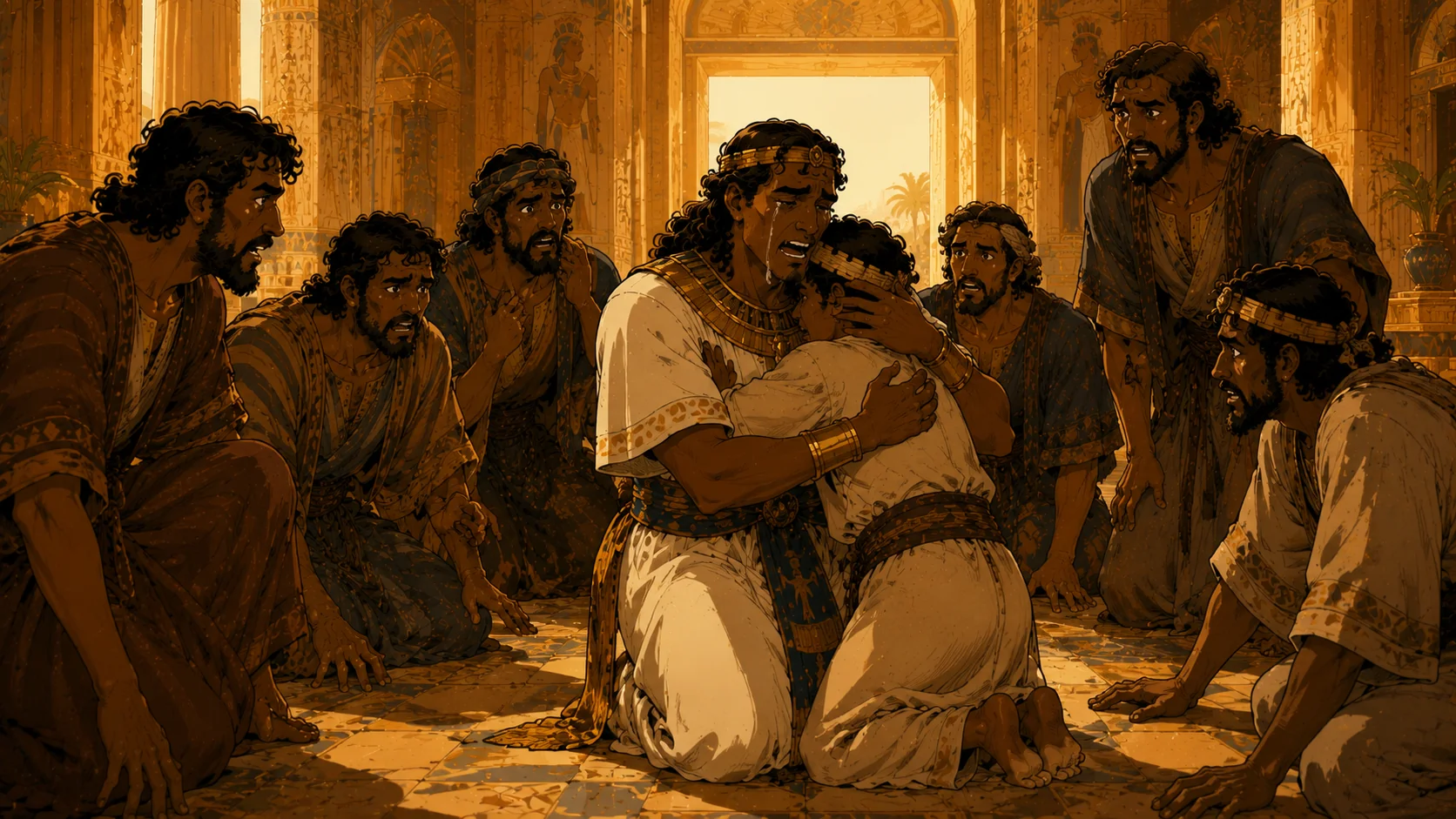
That was the moment. Yosef could not restrain himself. He cleared the room of Egyptians and wept so loudly that all of Egypt heard. Then: Ani Yosef — "I am Yosef." Five words. The most dramatic revelation in the Torah. "Is my father still alive?" His brothers could not answer — they were terrified. He said it again: "I am Yosef your brother, whom you sold into Egypt. And now — do not be grieved or angry with yourselves. God sent me before you to preserve life." The evil the brothers intended had been the precise vehicle of Providence.
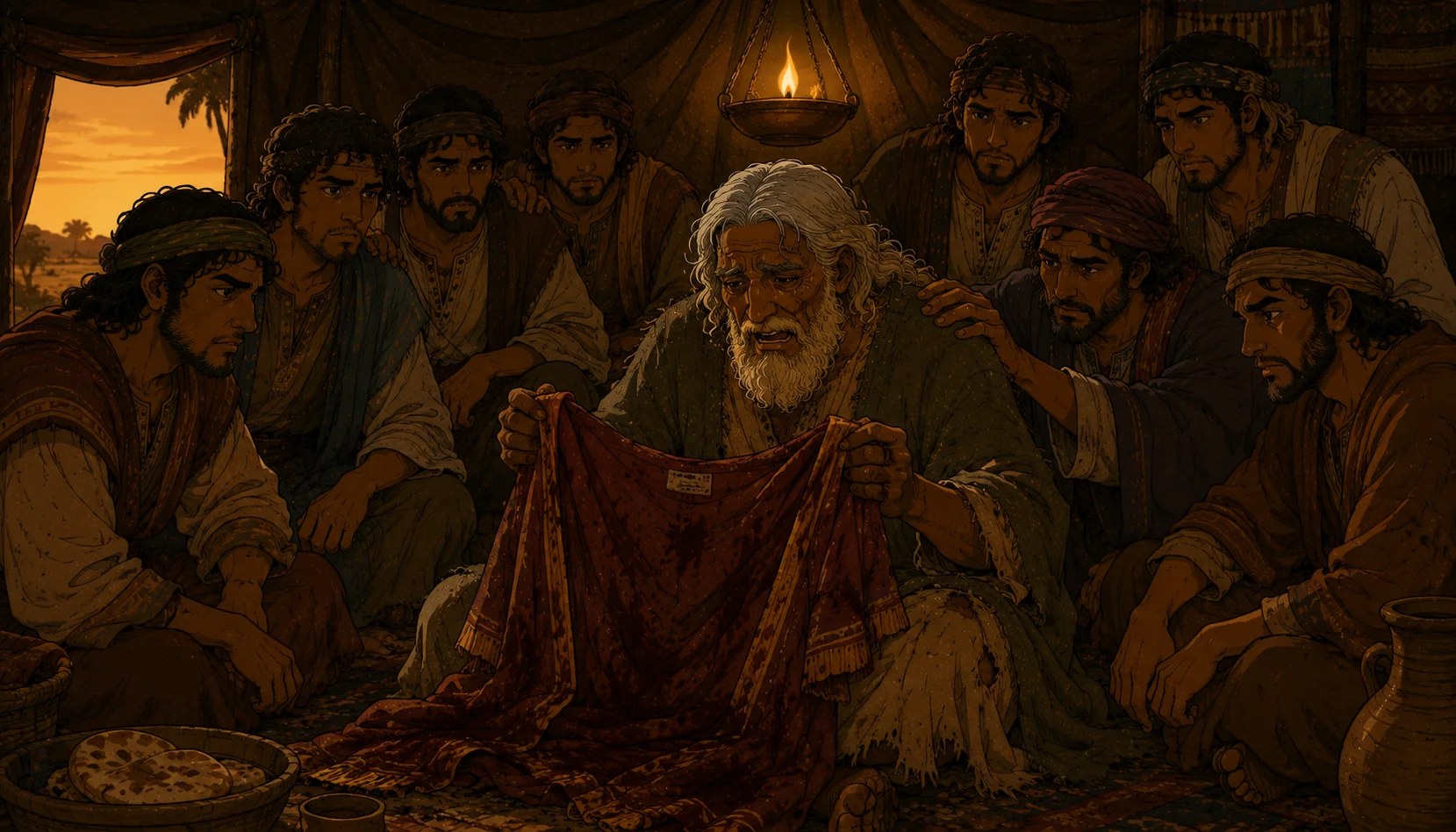 Bereshit 37:29–35 — Ya'akov received the coat dipped in goat's blood and refused to be comforted. The loss he mourned was not yet final — but he could not know that for twenty-two years.
The brothers sold Yosef to remove him from the story. Instead, they delivered him to the position from which he would save their lives — and the lives of seventy nations.
Ya'akov came with all his household — seventy souls in all. Elohim appeared to him at Beer-sheba on the journey and said: "Do not fear going down to Egypt, for I will make you a great nation there. I will go down with you, and I will also surely bring you back up." This descent was not an accident of famine. It was a divine relocation — the beginning of a four-hundred-year stay that would forge a nation in the furnace of slavery, as Avraham had been told it would. Ya'akov was reunited with Yosef after twenty-two years. He told Pharaoh his age — 130 — and said his days had been few and hard, not reaching the years of his fathers. He lived seventeen more years in Egypt.
Ya'akov blessed Ephraim and Menasheh with hands crossed — giving the younger the greater blessing, one more echo of every unexpected reversal that had come before. He blessed his twelve sons with prophetic words over each tribe's character. He made Yosef swear to bury him in the Cave of Machpelah, not Egypt. Yosef fulfilled it. After Ya'akov's death, his brothers feared revenge. Yosef wept. Then he said the words that close the arc: "You intended evil against me. God intended it for good." Yosef died at 110. His last instruction: when God visits you and brings you up from this land, carry my bones with you. He had lived long enough to know what was coming for his people — and he wanted to go home.
