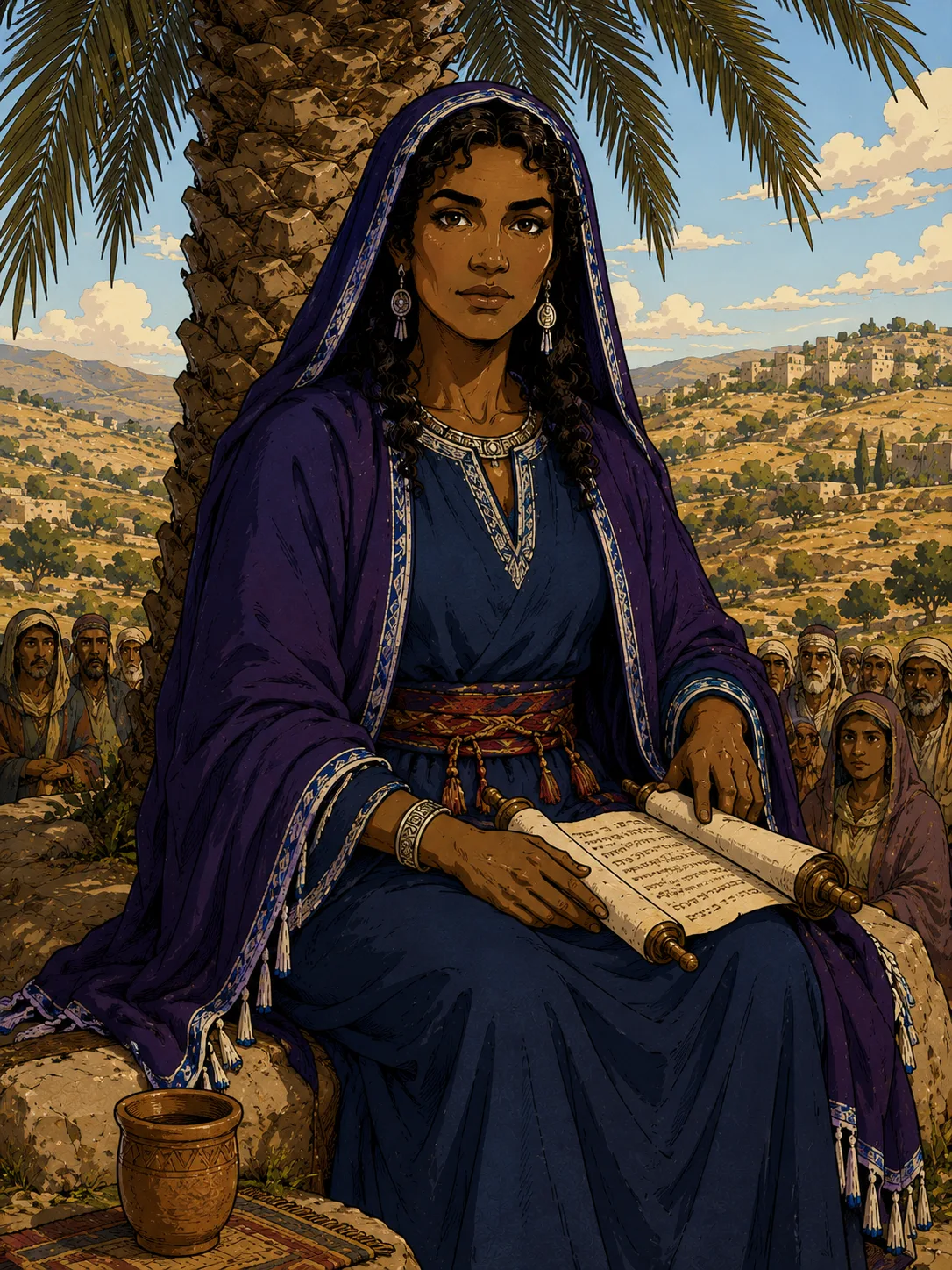
Judges 4 introduces Devorah simply as “a prophetess, the wife of Lapidot” who “was judging Israel at that time.” She held court under a palm tree between Ramah and Beit-El, in the hill country of Efrayim — the only woman among the judges named in Scripture, and one of very few women anywhere in the Hebrew Bible explicitly called a prophetess.
When Israel was oppressed by Yavin, king of Hatzor, and his commander Sisera, Devorah summoned Barak of Naftali and relayed Yah’s battle plan directly: gather ten thousand men at Mount Tavor, and Yah would give Sisera into his hand. Barak’s reply — “if you will go with me, I will go; but if you will not go with me, I will not go” — is itself a measure of how Israel saw her authority. She went. The battle was won, and Sisera fled the field only to be killed by another woman, Yael, in her tent (Judges 4:17–22).
Judges 5 — the Song of Devorah — is, by most reckonings, among the oldest pieces of poetry preserved in the Hebrew Bible, composed by Devorah and Barak together to commemorate the victory. It names tribe after tribe by their response to the battle, some who came and some who stayed home, and gives Devorah a title found nowhere else in this exact form: “a mother in Israel” (Judges 5:7).
Some traditions connect Devorah to the tribe of Yissachar, noting that Judges 5:15 places “the princes of Yissachar” alongside her in the song, even though her courtroom sat in Efrayim’s hill country — this dataset notes the question without resolving it. Hebrews 11:32 closes its roll call of the faithful by naming “the judges” as a group rather than individually, but Devorah’s place among them — prophetess, judge, and the only woman whose own song survives in the text — is hard to overstate.