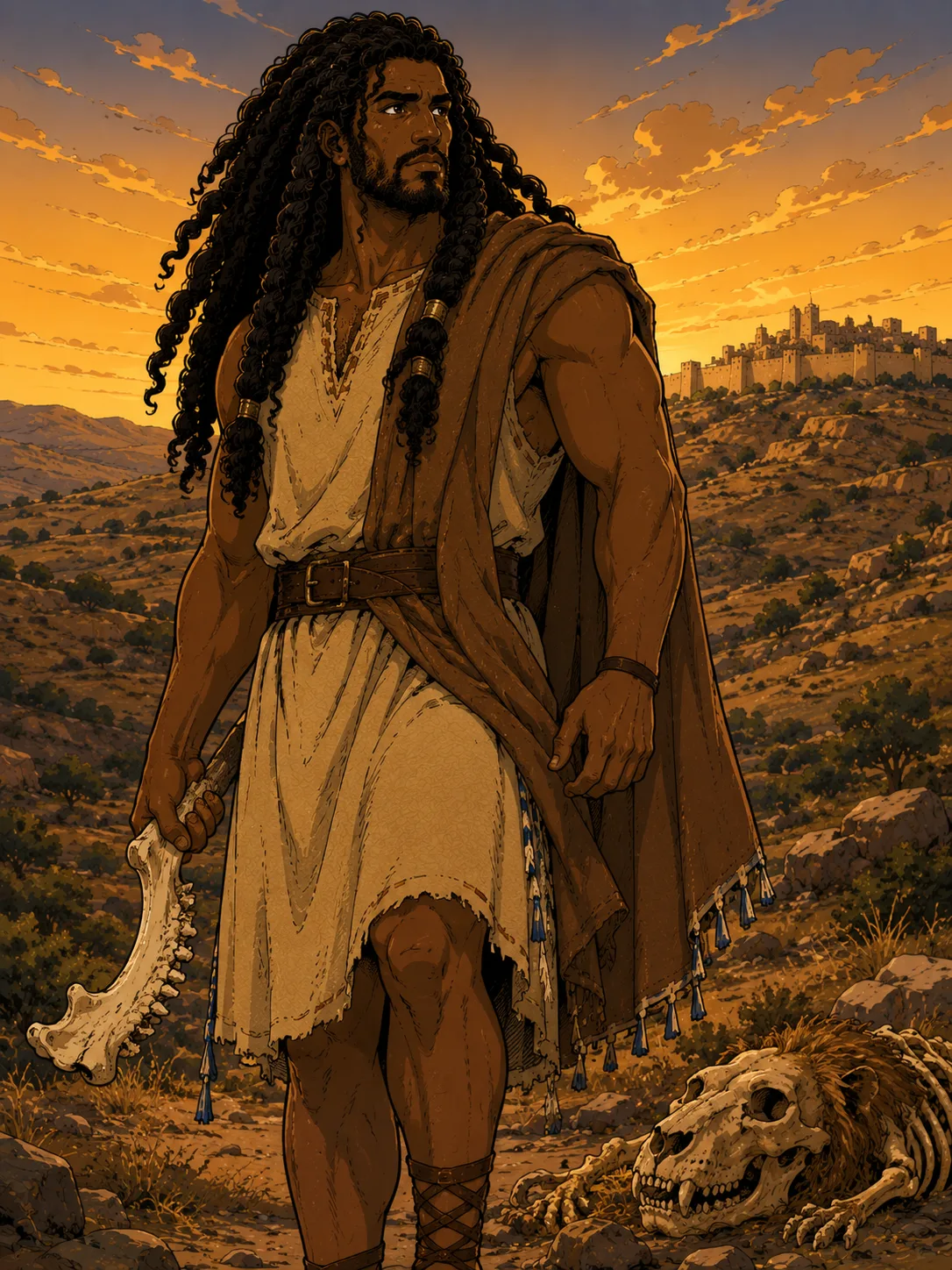
Shimshon’s story begins before his birth. Judges 13 records the angel of Yah appearing to Manoach and his wife — both otherwise unnamed in the text — announcing a son who would be a Nazirite from the womb: no wine, no contact with the dead, and hair that would never be cut. He would begin to deliver Israel from the Philistines.
Judges 14–15 shows that deliverance arriving through riddles and raw strength rather than armies. Shimshon turned a wedding riddle about a lion and a honeycomb into a contest with the Philistines, killed a thousand men with the jawbone of a donkey after being bound and handed over by his own people, and — in one of the book’s most vivid images — tore the city gates of Gaza off their posts and carried them away on his shoulders (Judges 16:1–3).
His undoing came not from an army but from Delilah, who pressed him until he revealed the secret of his strength: the unshorn hair of his vow. Cut, betrayed, and blinded, Shimshon was set to grinding grain in a Philistine prison (Judges 16:4–22) — until, in the temple of Dagon, his hair grown back and his strength returned, he pulled down the pillars on himself and the Philistine lords gathered there, “so the dead that he killed at his death were more than he had killed in his life” (Judges 16:30).
Shimshon’s hair is more than a plot device — within this dataset’s canon notes, he is the one figure whose long, unshorn hair is itself the visible sign of his consecration, not merely a stylistic choice. Hebrews 11:32 names him directly among the heroes of faith, alongside Gideon, Yiftach, David, and Shmuel — a list that does not erase his failures so much as insist that, in the end, Yah used even a flawed deliverer to begin Israel’s rescue from the Philistines.